Cursor API provider and the Cursor CLI passthrough
Two ways to put Cursor behind OmniRoute without an IDE session:
cursor-apiprovider (card “Cursor API”, aliascua): an API-key provider that holds a Cursor user API key (crsr_…, generated athttps://cursor.com/dashboard/api). Any OmniRoute client then reaches Cursor models through/v1/chat/completionsascursor-api/<model>orcua/<model>, with the usual quota, fallback and logging layers. The IDE provider (cursor, OAuth/IDE session) is unchanged.- Cursor CLI passthrough: point the Cursor CLI (
agent) at OmniRoute so every RPC the CLI makes is authenticated with an OmniRoute API key, forwarded to Cursor with acursor-apiconnection’s credential, and recorded in the Logs page.
Why the key is exchanged
Section titled “Why the key is exchanged”api2.cursor.sh rejects a raw crsr_… key as a Bearer token (401). The Cursor
CLI first POSTs the key to /auth/exchange_user_api_key and receives a session
JWT that expires after one hour; the returned refreshToken carries the same
exp, so refreshing means re-exchanging the key.
open-sse/services/cursorApiKeyAuth.ts does that exchange, caches one session
token per key, re-exchanges five minutes before expiry and drops the cached
token when Cursor answers 401. CursorExecutor calls it right before opening
the upstream stream for cursor-api connections.
The cursor-api provider
Section titled “The cursor-api provider”Registry: open-sse/config/providers/registry/cursor/index.ts
(cursor_apiProvider, authType: "apikey", same format, baseUrl and
models as cursor). Catalog card:
src/shared/constants/providers/apikey/specialty-media.ts. Executor map:
open-sse/executors/index.ts ("cursor-api" / cua →
new CursorExecutor("cursor-api")).
Dashboard: Providers → Cursor API → Add API key.
REST:
curl -sS -X POST http://localhost:20128/api/providers \ -H "Content-Type: application/json" \ -d '{"provider":"cursor-api","name":"cursor-api-key","apiKey":"crsr_…","priority":1}'Then:
curl -sS http://localhost:20128/v1/chat/completions \ -H "Authorization: Bearer <omniroute-api-key>" \ -H "Content-Type: application/json" \ -d '{"model":"cursor-api/auto","messages":[{"role":"user","content":"say PONG"}]}'Notes:
- Model listing for
cursor-apicomes from the static Cursor registry (the same list the IDE provider falls back to); nocursor-agentinstall is needed on the OmniRoute host. POST /api/providers/{id}/refresh-cursoris for thecursorIDE provider only;cursor-apiconnections have no IDE session to renew.
Native model IDs and effort
Section titled “Native model IDs and effort”For cursor / cu and cursor-api / cua, the shared Claude-effort normalizer
leaves the requested model ID intact. Cursor can advertise a suffix such as
-low as part of a real model ID, rather than as an OmniRoute effort alias.
The Cursor executor preserves an exact live-catalog match; when there is no
match, its existing model resolver owns suffix-to-parameter fallback.
This does not change effort normalization for direct Claude, Claude-compatible, or Vertex routes. Availability still depends on the selected Cursor account’s catalog and entitlement.
Cursor CLI passthrough
Section titled “Cursor CLI passthrough”Route: src/app/api/cursor-cli/[...path]/route.ts →
open-sse/handlers/cursorCliProxy.ts. The prefix /api/cursor-cli/ is
registered in src/shared/constants/publicApiRoutes.ts because the handler
enforces its own authentication:
| Path | Auth expected from the CLI | What OmniRoute does |
|---|---|---|
POST /auth/exchange_user_api_key |
Bearer <OmniRoute API key> |
Validates the key, mints a 1h HS256 JWT (signed with JWT_SECRET) and returns it |
every other path (/aiserver.v1.*, /agent.v1.AgentService/RunSSE, /aiserver.v1.BidiService/BidiAppend, /v1/traces, …) |
Bearer <that JWT> |
Verifies issuer/audience/expiry, picks an active cursor-api connection, swaps the Authorization header for the exchanged Cursor token and streams the reply back |
The CLI decodes exp from whatever token it receives, so handing it an opaque
token makes it re-exchange before almost every request; the minted JWT avoids
that. A 401 from OmniRoute makes the CLI exchange again.
-
Create an OmniRoute API key (Dashboard → API keys) and a
cursor-apiconnection. -
Tell the CLI to use HTTP/1.1 for the agent stream. In
~/.cursor/cli-config.json:{ "network": { "useHttp1ForAgent": true } }Without this the CLI opens the agent turn over HTTP/2 to a separately configured agent host and only the control-plane RPCs go through the endpoint.
-
Run the CLI against OmniRoute:
Terminal window export CURSOR_API_ENDPOINT=http://localhost:20128/api/cursor-cliexport CURSOR_API_KEY=<omniroute-api-key>agent -p --trust "Reply with exactly OK"
Every hop lands in Logs as provider cursor-api, request type cursor-cli,
path /api/cursor-cli/<rpc>, attributed to the OmniRoute API key and the
connection that served it.
Failure modes
Section titled “Failure modes”| Situation | Response to the CLI |
|---|---|
Unknown OmniRoute key and REQUIRE_API_KEY=true |
401 unauthenticated on exchange |
REQUIRE_API_KEY=false |
anonymous session (mirrors /v1/* behaviour) |
| Expired / foreign / tampered session JWT | 401, the CLI re-exchanges |
| OmniRoute API key revoked after exchange | 401 on the next RPC |
No active cursor-api connection |
503 unavailable |
| Cursor rejects the connection’s key | 401 unauthenticated, cached session dropped |
| Upstream unreachable | 502 unavailable (sanitized message) |
JWT_SECRET unset |
503 on exchange |
HagiCode
HagiCode is an agentic coding workspace: structured workflows, multi-agent execution, and Hero Dungeon views turn ideas into shipped software.
Turn ideas into polished, usable software with a smarter, faster, and more enjoyable agentic coding workflow.
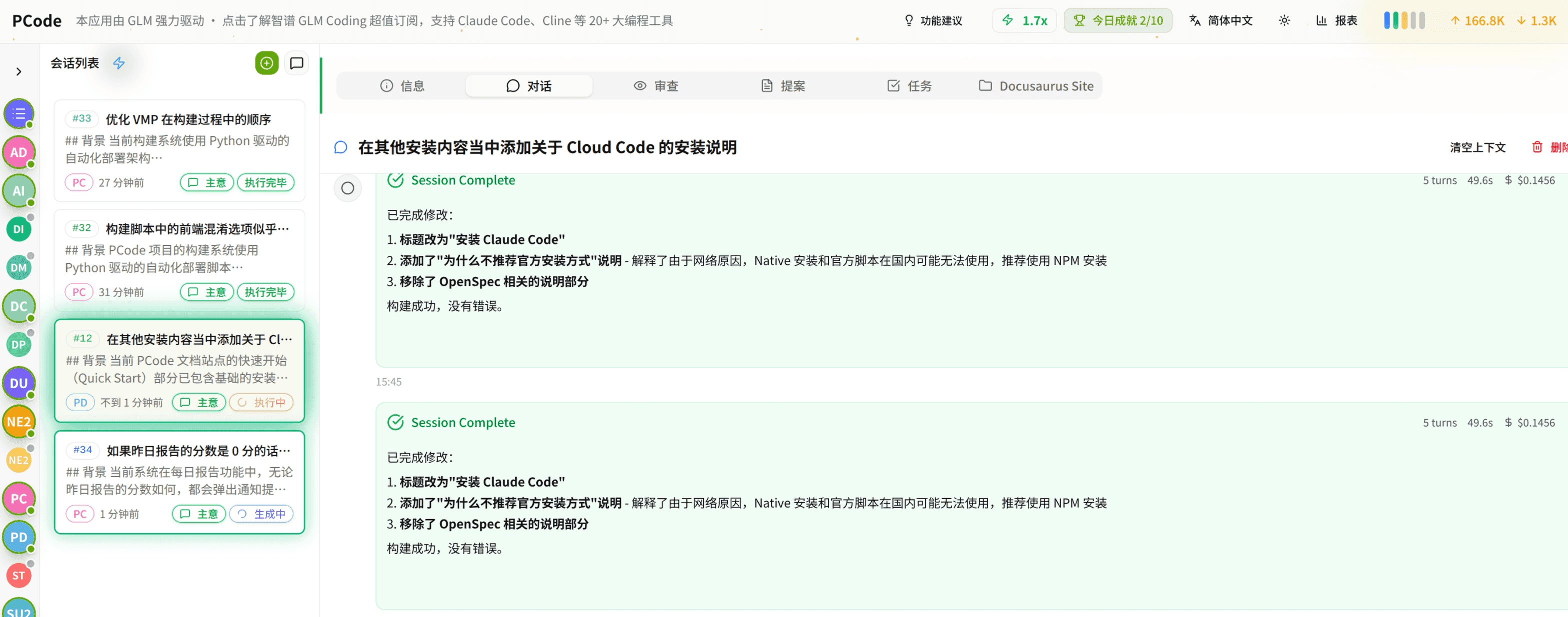
- SmartStructured workflows turn intent into an executable path from idea to shipped change.
- EfficientMulti-agent workflows keep research, implementation, and review moving in parallel.
- FunHero Dungeon interfaces make long coding sessions visual, collaborative, and rewarding.