OmniRoute Auto-Combo Engine
For Users: Looking for a quick start? See the Auto-Combo User Guide for simple explanations and examples.
Self-managing model chains with adaptive scoring + zero-config auto-routing
Zero-Config Auto-Routing (auto/ prefix)
Section titled “Zero-Config Auto-Routing (auto/ prefix)”NEW: No combo creation required. Use
auto/prefix directly in any client.
Quick Examples
Section titled “Quick Examples”| Model ID | Variant | Behavior |
|---|---|---|
auto |
default | All connected providers, LKGP strategy, balanced weights |
auto/coding |
coding | Quality-first weights, suitable for code generation |
auto/fast |
fast | Low-latency weighted selection |
auto/cheap |
cheap | Cost-optimized routing (lowest cost first) |
auto/offline |
offline | Favors providers with highest quota availability |
auto/smart |
smart | Quality-first + higher exploration rate (10%) for better model discovery |
auto/lkgp |
lkgp | Explicit LKGP (same as default auto) |
auto/chaos |
chaos | Fault-injection weights for resilience testing (chaos engineering) |
Category × Tier Composition (auto/<category>:<tier>)
Section titled “Category × Tier Composition (auto/<category>:<tier>)”OpenRouter-style suffixes separate what kind of route (category) from how to optimize it (tier), so you can compose them freely (#4235 Phase B, open-sse/services/autoCombo/suffixComposition.ts):
- Categories (filter the candidate pool by capability):
coding·reasoning·vision·chat·multimodal.vision/multimodalkeep vision-capable models;reasoningkeeps reasoning/thinking models. - Tiers (pick the scoring weights / pool filter):
fast(ship-fast) ·cheap(aliasfloor, cost-saver) ·reliable(circuit-breaker health + latency stability) ·free/pro(filter the pool by model tier viaclassifyTier— free-tier vs. premium).
| Example | Resolves to |
|---|---|
auto/coding:fast |
coding pool, low-latency weights |
auto/coding:cheap |
coding pool, cost-optimized (alias auto/coding:floor) |
auto/reasoning:pro |
reasoning/thinking models only, premium tier |
auto/vision |
vision-capable models (no tier → balanced weights) |
auto/multimodal:free |
multimodal-capable models, free tier only |
Any valid auto/<category>[:<tier>] resolves on demand; a curated subset is advertised in /v1/models and the dashboard (AUTO_SUFFIX_VARIANTS in open-sse/services/autoCombo/builtinCatalog.ts). Filtering is fail-open — if a constraint matches no connected models, the full pool is used so routing never breaks. The core scorer (combo.ts) is unchanged; the category/tier filter is applied in buildAutoCandidates.
Live model intelligence: auto-routing fitness is informed by live Arena ELO rankings + models.dev tier data when the
ARENA_ELO_SYNC_ENABLEDflag is on (falls back to the static fitness map otherwise).
How to use:
# Any IDE or CLI tool that supports OpenAI formatBase URL: http://localhost:20128/v1API Key:  <your-endpoint-key>
# In your code/config, set model to:model: "auto"                 # balanced defaultmodel: "auto/coding"          # best for coding tasksmodel: "auto/fast"            # fastest availablemodel: "auto/cheap"           # cheapest per token
What happens:
- OmniRoute detects
auto/prefix insrc/sse/handlers/chat.ts - Queries all active provider connections from the database
- Filters to those with valid credentials (API key or OAuth token)
- Determines the model per connection (
connection.defaultModelor provider’s first model) - Builds a virtual combo in-memory (not stored in DB)
- Routes using the selected variant’s weight profile + LKGP strategy
Key properties:
- ✅ Always-on: No toggle, no combo creation, no configuration needed
- ✅ Dynamic: Reflects current connected providers automatically
- ✅ Session stickiness: LKGP ensures last successful provider is prioritized
- ✅ Multi-account aware: Each provider connection becomes a separate candidate
- ✅ No DB writes: Virtual combo exists only for the request, zero persistence overhead
Per-key candidate control (#7819, Level 1+2)
Section titled “Per-key candidate control (#7819, Level 1+2)”GET /v1/auto-combo/{channel}/candidates ({channel} = the suffix after auto/, or
the literal auto for the base channel) is a read-only endpoint that lists an
auto/* channel’s current candidate pool decorated with live reachability, reusing
the existing resilience reads (never raw breaker state):
- provider circuit breaker —
getCircuitBreaker(provider).getStatus()/.canExecute() - connection cooldown —
rateLimitedUntil/testStatuson the resolvedprovider_connectionsrow - model lockout —
isModelLocked(provider, connectionId, model)
Each candidate also carries this API key’s excluded flag. Exclusions are stored
per-API-key (auto_candidate_overrides table, migration 128) — OmniRoute is
single-tenant with no users table, so apiKeyId is the closest real per-caller
identity — and enforced at the candidate-pool chokepoint in
open-sse/services/autoCombo/virtualFactory.ts via the pure, unit-tested
filterExcludedCandidates() (open-sse/services/autoCombo/candidateOverrides.ts).
The filter is fail-open: an unset apiKeyId/channel or a DB lookup failure both
leave the pool unfiltered, so an operator with no overrides configured sees routing
byte-identical to before this feature.
Deferred to a follow-up issue: per-candidate weights + explicit ordering (Level 3
— feeds into the existing weighted/priority strategy paths) and pinning a specific
combo.ts strategy per auto/* channel (Level 4). See the #7819 plan for the open
question on whether overrides should stay per-API-key or become global given the
single-tenant model.
Behind the scenes:
Request: { model: "auto/coding" } ↓src/sse/handlers/chat.ts detects prefix ↓createVirtualAutoCombo('coding') → candidatePool from active connections ↓handleComboChat (same engine as persisted combos) ↓Auto-scoring selects best provider/model per requestImplementation files:
| File | Purpose |
|---|---|
open-sse/services/autoCombo/autoPrefix.ts |
Prefix parser (parseAutoPrefix) |
open-sse/services/autoCombo/virtualFactory.ts |
Creates virtual AutoComboConfig objects |
open-sse/services/autoCombo/providerRegistryAccessor.ts |
Test hook for mocking provider registry |
src/sse/handlers/chat.ts |
Integration: auto prefix short-circuit |
src/shared/constants/providers.ts |
SYSTEM_PROVIDERS.auto system entry |
Combo Names That Match a Real Model Id
Section titled “Combo Names That Match a Real Model Id”A combo whose name is identical to a bare model id (e.g. a combo named
gpt-5.5) is an intentional, supported pattern, not a bug: it is the
mechanism for per-model-id provider fallback documented in
#6940. Because combo
resolution is checked before bare-model-id resolution
(getComboForModel() in src/sse/services/model.ts), a request for the bare
id gpt-5.5 is routed through the combo’s targets (e.g.
acme-responses/gpt-5.5, backup-responses/gpt-5.5) instead of straight to
a single provider — this reuses the combo-before-rewrite precedence built for
#3227/#3233 and is
regression-tested by tests/unit/responses-combo-resolution-3227.test.ts and
tests/unit/combo-name-codex-responses-rewrite.test.ts.
Creating or renaming a combo to a name that shadows a real model id is
never rejected — doing so would break this documented workflow. Instead
(#8530), POST /api/combos and PUT /api/combos/[id] attach a non-blocking
warning field to the response when the (new) name collides with a real
model id:
{ "warning": { "code": "COMBO_NAME_SHADOWS_MODEL", "modelId": "gpt-5.5", "providerId": "openai" } }At boot, scanComboModelNameCollisionsAtBoot()
(src/instrumentation-node.ts) also logs a one-line [STARTUP] warning
enumerating every existing combo that shadows a model id, so operators who
hit this by accident (rather than intentionally, per #6940) have a signal.
The detection helper lives in src/lib/combos/modelNameCollision.ts.
Calling a Custom Combo From a Client
Section titled “Calling a Custom Combo From a Client”Persisted combos (Settings → Combos) are only used when the client sends the combo’s exact name in the model field — there is no fuzzy or partial matching of the combo name, and no auto/ prefix involved. Resolution order (getComboForModel() in src/sse/services/model.ts):
- exact combo-name match (
model: "my-combo"), combo/<name>prefix (model: "combo/my-combo"),- model→combo glob mappings (
/api/model-combo-mappings).
curl -X POST http://localhost:20128/v1/chat/completions \ -H "Authorization: Bearer <key>" \ -H "Content-Type: application/json" \ -d '{"model":"my-combo","messages":[{"role":"user","content":"Hello"}]}'Two common pitfalls:
autodoes not use your combos.auto/auto/*builds its own zero-config candidate pool and only consults persisted combos if a combo is literally namedauto(not recommended). To route through a combo, send its exact name — notauto.openrouter/autois a real paid OpenRouter product (“Auto Best Available”), not an OmniRoute alias. It is the single static model entry of the OpenRouter registry (open-sse/config/providers/registry/openrouter/index.ts) and is billed separately. Use Settings → Routing → Hide paid models to exclude it fromautopools.
See #7992 and #7111 for the original confusion this documents.
How It Works (Persisted Auto-Combos)
Section titled “How It Works (Persisted Auto-Combos)”The Auto-Combo Engine dynamically selects the best provider/model for each request using a 16-factor scoring function (defined in open-sse/services/autoCombo/scoring.ts → DEFAULT_WEIGHTS). The default weights sum to 1.0; custom weights are renormalized by normalizeScoringWeights(). Two of the sixteen — cacheAffinity and resetWindowAffinity — carry a default weight of 0; reliability carries 0 in DEFAULT_WEIGHTS but 0.03 in generic packs and 0.04 in reliability-first, and quality carries 0.02 in packs (0.03 in quality-first): they are still computed for every candidate, and cacheAffinity gates prompt-cache deduplication outside the score, so the zero-default factors simply do not vote by default while packs do.

Source: diagrams/auto-combo-scoring.mmd (regenerate via
npm run docs:render-diagrams). The filename is historical; the source and rendered diagram show all 16 factors declared inDEFAULT_WEIGHTS.
| Factor | Default Weight | Description |
|---|---|---|
quota |
0.1429 | Remaining quota / rate-limit headroom [0..1] |
health |
0.1605 | Health score from circuit breaker (CLOSED=1.0, HALF_OPEN=0.5, OPEN=0.0) |
costInv |
0.1429 | Inverse blended cost (60% input + 40% output token price, normalized) — cheaper = higher score |
latencyInv |
0.1143 | Inverse p95 latency normalized to pool — faster = higher score |
taskFit |
0.0762 | Task-type fitness (coding, review, planning, analysis, debugging, docs) |
stability |
0.0476 | Variance-based stability from latency standard deviation — a candidate whose response time swings scores lower |
tierPriority |
0.0476 | Account-tier priority — Ultra=1.0, Pro=0.67, Standard=0.33, Free=0.0 |
tierAffinity |
0.0476 | Affinity between the candidate’s tier and the manifest-recommended tier |
specificityMatch |
0.0476 | Match between request specificity (manifest hint) and model tier |
contextAffinity |
0.0476 | Affinity between the request’s context-window need and the model’s context window |
sessionAvailability |
0.0476 | OAuth session availability of the candidate connection for this session (getOAuthSessionAvailability(); non-OAuth connections score 1.0) |
connectionDensity |
0.0476 | Spreads load across connections of the same provider (anti-concentration) |
cacheAffinity |
0.00 | Rendezvous-hash affinity toward the connection likeliest to already hold this request’s prompt-cache prefix (open-sse/services/combo/promptCacheAffinity.ts); disabled by default (#8008) |
resetWindowAffinity |
0.00 | Bias toward connections whose quota reset window is favorable (disabled by default) |
quality |
0.03 | Feedback-driven output-quality signal from the routing-event quality tracker; candidates without observations receive a neutral 0.5 |
reliability |
0.00 | Observed success share, 1 - failureRate, from 24h of usage history behind a ten-sample floor (real-time metrics otherwise); candidates with no observations read as 1.0. Disabled by default |
Sum: 0.1429 + 0.1605 + 0.1429 + 0.1143 + 0.0762 + (7 × 0.0476) + 0.00 + 0.00 + 0.03 + 0.00 = 1.0 as declared in DEFAULT_WEIGHTS; user-configured weights are renormalized into a distribution by normalizeScoringWeights() before scoring.
Mode Packs
Section titled “Mode Packs”6 pre-defined weight profiles in open-sse/services/autoCombo/modePacks.ts. Each pack replaces the default weights outright to bias selection toward one goal. Every pack already sums to 1.0 (0.9999 as printed at four decimals), so normalizeScoringWeights() has nothing meaningful to correct when a pack is active — the values below are, to rounding, the ones the scorer applies.
| Factor | ship-fast | cost-saver | quality-first | offline-friendly | reliability-first | chaos-mode |
|---|---|---|---|---|---|---|
quota |
0.1133 | 0.1133 | 0.0752 | 0.3324 | 0.1133 | 0.0376 |
health |
0.2667 | 0.1810 | 0.1714 | 0.2667 | 0.3524 | 0.4000 |
costInv |
0.0276 | 0.3324 | 0.0276 | 0.0752 | 0.0181 | 0.0140 |
latencyInv |
0.3048 | 0.0476 | 0.0476 | 0.0476 | 0.0476 | 0.0186 |
taskFit |
0.0952 | 0.0952 | 0.3524 | 0.0000 | 0.0952 | 0.1905 |
stability |
0.0000 | 0.0476 | 0.1429 | 0.0952 | 0.1905 | 0.1714 |
tierPriority |
0.0376 | 0.0376 | 0.0276 | 0.0376 | 0.0276 | 0.0040 |
tierAffinity |
0.0000 | 0.0000 | 0.0000 | 0.0000 | 0.0000 | 0.0000 |
specificityMatch |
0.0000 | 0.0000 | 0.0000 | 0.0000 | 0.0000 | 0.0000 |
contextAffinity |
0.0095 | 0.0000 | 0.0000 | 0.0000 | 0.0000 | 0.0186 |
sessionAvailability |
0.0476 | 0.0476 | 0.0476 | 0.0476 | 0.0476 | 0.0476 |
resetWindowAffinity |
0.0000 | 0.0000 | 0.0000 | 0.0000 | 0.0000 | 0.0000 |
connectionDensity |
0.0476 | 0.0476 | 0.0476 | 0.0476 | 0.0476 | 0.0476 |
quality |
0.02 | 0.02 | 0.03 | 0.02 | 0.02 | 0.02 |
reliability |
0.03 | 0.03 | 0.03 | 0.03 | 0.04 | 0.03 |
Notes:
- Packs carry
qualityandreliability(quality 0.02,quality-first 0.03;reliability 0.03,reliability-first 0.04) and replace the weight map wholesale (weights = pack, not a merge).DEFAULT_WEIGHTScarriesquality 0.03 / reliability 0; selectingbalanced/defaultkeeps those defaults, selecting a pack uses the pack’s values above. On a cold pool (no observations yet, soquality 0.5andreliability 1) these two factors add+0.04under a generic pack (0.03 + 0.01),+0.045underquality-firstand+0.05underreliability-first. tierAffinity,specificityMatchandresetWindowAffinityare explicitly0in every pack.- Each pack’s emphasis at a glance:
- ship-fast → latencyInv 0.3048 + health 0.2667 (low-latency, healthy connections)
- cost-saver → costInv 0.3324 (cheapest tokens win)
- quality-first → taskFit 0.3524 + stability 0.1429 + quality 0.03, the highest of any pack (best model for the task, consistent)
- offline-friendly → quota 0.3324 + health 0.2667 (max headroom regardless of speed/cost)
- reliability-first → health 0.3524 + stability 0.1905 + reliability 0.04, the highest of any pack (fewest surprises)
- chaos-mode → health 0.4000 + taskFit 0.1905 (fault-injection profile)
Per-Request Controls (headers) — #6023 / #6024 / #6025 / #3470
Section titled “Per-Request Controls (headers) — #6023 / #6024 / #6025 / #3470”An auto combo can be steered per request via three headers, without mutating the
combo’s stored config. These apply only to the auto strategy and only for the request
that carries them; the combo’s saved modePack/budgetCap/budgetFallback are used
when the header is absent.
| Header | Accepts | Effect |
|---|---|---|
X-OmniRoute-Mode |
a preset alias (fast, balanced, quality, cheap, reliable, offline) or a raw pack name (ship-fast, cost-saver, quality-first, offline-friendly, reliability-first) |
Overrides the scoring weights for this request. balanced/default force the default weights (no pack). Unknown values are ignored (config preserved). |
X-OmniRoute-Budget |
a positive number (max USD per request) | Hard cost ceiling: candidates whose estimated cost exceeds it are filtered before selection. What happens when every candidate exceeds it is controlled by X-OmniRoute-Budget-Fallback below. |
X-OmniRoute-Budget-Fallback |
cheapest (default, aliases: cheapest-viable, soft) or strict (aliases: block, hard) |
cheapest: falls back to the globally cheapest candidate even though it still exceeds the cap (legacy behavior). strict: refuses to select — the request fails fast with HTTP 402 instead of silently overspending. Unknown values are ignored. |
X-OmniRoute-Effort |
auto (other values reserved) |
Adaptive thinking budget: when the request carries no reasoning field of any shape (reasoning_effort, reasoning, thinking), the gateway resolves auto to low/medium/high from deterministic request-shape signals (last-user-message length, context size up to the last user message, prior tool results, tool-loop depth). Signals are scoped to the current turn — everything after the last user message is ignored — so every request in a tool loop resolves to the same level (stateless per-turn pin, no session state, no mid-loop escalation that would break upstream prompt-cache prefixes). An explicit client reasoning field always wins. Scoped to requests whose upstream dispatch resolves to the OpenAI Chat Completions shape (targetFormat === FORMATS.OPENAI) — reasoning_effort is an OpenAI-shaped field, so the header is a no-op on a Claude- or Gemini-targeted request (see open-sse/handlers/chatCore/adaptiveEffortWiring.ts). |
# Force the fastest profile, cap this request at $0.05, and hard-block instead of overspendingcurl -sS http://localhost:20128/v1/chat/completions \ -H "Content-Type: application/json" \ -H "X-OmniRoute-Mode: fast" \ -H "X-OmniRoute-Budget: 0.05" \ -H "X-OmniRoute-Budget-Fallback: strict" \ -d '{"model":"auto","messages":[{"role":"user","content":"hi"}]}'Resolution is a pure function (open-sse/services/autoCombo/requestControls.ts); the
resolved values feed the engine’s existing config.modePack / config.budgetCap /
config.budgetFallback inputs. A combo’s stored config.budgetFallback (“strict” |
“cheapest”) sets the persistent policy; the header overrides it for a single request.
All Routing Strategies
Section titled “All Routing Strategies”OmniRoute’s combo engine supports 19 routing strategies (declared in src/shared/constants/routingStrategies.ts → ROUTING_STRATEGY_VALUES). The Auto Combo engine itself is exposed under the auto strategy; the others are available for persisted combos.
| Strategy | Description |
|---|---|
priority |
First-target ordered list with explicit priority |
weighted |
Weighted random by per-target weight |
round-robin |
Cycle through targets in order (batched; see below) |
context-relay |
Hand off context across targets (long conversations) |
fill-first |
Fill each target’s quota before moving to next |
p2c |
Power-of-2-choices random load balancing |
random |
Uniform random selection |
least-used |
Pick target with lowest current load |
cost-optimized |
Minimize $ per request given catalog pricing |
reset-aware ⭐ |
Prioritize by quota reset time — short reset windows ranked higher |
reset-window |
Prefer targets whose quota window resets soonest |
headroom |
Pick the target with the most remaining quota headroom |
strict-random |
Random without deduplication of repeats |
auto |
Use Auto Combo scoring (16-factor) — recommended |
lkgp |
Last-Known-Good Path (pins to the last successful provider, then falls back to rules) |
context-optimized |
Pick target with best fit for current context size |
cache-optimized |
Reorder targets by prompt-cache affinity — the connection likeliest to already hold this request’s cached prefix is tried first (open-sse/services/combo/promptCacheAffinity.ts, #8008) |
fusion 🧬 |
Fan out to a panel of models in parallel, then synthesize one answer via a judge (see below) |
pipeline |
Run targets sequentially, threading each step’s output into the next step’s input; only the final answer is returned (#6396) |
⭐ = New in v3.8.0 · 🧬 = New in v3.8.36
weighted semantics
Section titled “weighted semantics”weighted is a proportional random draw per request
(open-sse/services/combo/targetSorters.ts → selectWeightedTarget), not an equalizer:
- Each request draws one step with probability
weight / totalWeight; the remaining steps are ordered by descending weight as the fallback chain for that request. - A step whose weight is
0(or missing) is never drawn while any other step has a weight > 0 — it can only serve as a fallback after the drawn step fails. Only when all weights are 0 does selection become uniform. - Steps whose targets are all unavailable — provider circuit breaker
OPEN, connection cooldown, model lockout — are removed from the draw before it happens (open-sse/services/combo/targetResolution.ts), so a single healthy step can temporarily win every request. stickyWeightedLimit(combo config, default1= off) pins the drawn step for that many consecutive successes before re-drawing.
For strict rotation use round-robin; equal weights on weighted give statistical — not
strict — balance.
Agentic pipeline mode
Section titled “Agentic pipeline mode”A two-step pipeline combo can opt into planner/executor routing with
config.agenticOrchestration.enabled. The first target owns planning and final answers;
the second target emits client-native tool calls. OmniRoute detects tool-result
continuations from the request protocol, asks the planner whether another tool round is
needed, and dynamically makes either the executor or planner the client-facing final
step.
{ "strategy": "pipeline", "models": [{ "model": "provider/planner" }, { "model": "provider/executor" }], "config": { "agenticOrchestration": { "enabled": true, "maxToolRounds": 8 } }}The executor may emit multiple independent calls in one response. Dependent calls are
handled in later client tool-result turns, with the planner reviewing every result.
maxToolRounds defaults to 8 and accepts 1–32; once reached, the planner must
produce the best available final answer. Internal planner decisions are buffered, while
the selected client-facing response preserves the original streaming preference.
round-robin sticky batch and account expansion
Section titled “round-robin sticky batch and account expansion”Round-robin is batched, not one-request-per-step:
stickyRoundRobinLimit(combo config, thencomboStickyRoundRobinLimit, thensettings.stickyRoundRobinLimit, default 3) keeps the same target for that many consecutive successes before rotating. Set the combo override to1for one-request rotation. The combo editor shows the effective value and which layer it came from.connectionAwareExpansion(combo config, then settings, default false) expands each provider-level step into per-account targets before rotation. Group-B strategies (priority, weighted, round-robin, random, p2c, least-used, cost-optimized, lkgp, fill-first, strict-random, context-optimized, cache-optimized, context-relay, fusion, pipeline) keep a provider-level view until this is on. The combo editor exposes inherit / on / off; inherit uses the global default (off).- Prompt-cache locality routing (
promptCacheAffinityEnabled, default true) reorders pinned connections so matching cache keys stay on one account. It takes precedence over round-robin and weighted rotation across pinned per-account steps. Turn it off under Settings → Combo defaults if you need strict rotation. There is no per-combo override.
For multi-account rotation on one model, prefer one dynamic-account step (empty
connectionId, whole pool) with sticky limit 1, not three pinned connectionIds.
Pinned steps plus affinity collapse onto the same account even while the RR counter
advances.
Fusion Strategy
Section titled “Fusion Strategy”fusion is the one strategy that does not pick a single target. It fans the prompt
out to every panel model in parallel, then a configurable judge model synthesizes
a single final answer from all panel responses. Ported from upstream decolua/9router
(OpenRouter’s Fusion design); implementation in open-sse/services/fusion.ts.
How it works:
- Tool-bearing bypass — a request that carries a non-empty
toolsarray withtool_choicenot explicitly"none"skips the panel entirely: it routes directly to a single model (the configured judge, orpanel[0]) withtools/tool_choicepassed through unmodified. Panel members have no tool access and the judge’s synthesis directive discourages tool-call emission, so agentic/tool-calling clients get a real tool-call decision instead of synthesized prose (#6771). - Fan-out (non-tool-bearing requests only) — the prompt is sent to every panel model at once, forced non-streaming with tools stripped (the judge needs complete prose to synthesize).
- Quorum-grace collection — as soon as
minPanelanswers arrive, a short grace timer starts for the stragglers, then fusion proceeds with whatever was collected. This caps the slowest model’s penalty on wall time, bounded by a hard timeout. - Judge synthesis — panel answers are anonymized (
Source 1,Source 2, … — so the judge weighs substance, not model brand) and handed to the judge, which analyzes consensus / contradictions / partial coverage / unique insights / blind spots, then writes one authoritative answer. The judge call keeps the client’s originalstreamflag + tools, so streaming and downstream tool use still work. - Graceful degradation — 0 panel answers →
503; exactly 1 survivor → that answer is returned directly (nothing to fuse); a single-model panel answers directly.
A panel member may also be a combo-ref step ({kind: "combo-ref", comboName: "..."}) referencing
another combo — it resolves as one black-box panel voice (a full recursive dispatch into the
referenced combo, not a fan-out of that combo’s own targets), with the same depth/cycle protection
every other combo-ref-consuming strategy already uses (#6764).
Configuration
Section titled “Configuration”Configured on the combo’s config blob (no schema migration — it reuses the existing
combos table):
| Field | Type | Default | Purpose |
|---|---|---|---|
config.judgeModel |
string |
first panel model | Model that synthesizes the final answer |
config.fusionTuning.minPanel |
number |
2 |
Successful answers required before the grace timer starts (clamped to [2, panelSize]) |
config.fusionTuning.stragglerGraceMs |
number |
8000 |
How long to wait for laggards once quorum is reached |
config.fusionTuning.panelHardTimeoutMs |
number |
90000 |
Absolute cap so one hung model can’t stall the request |
Defaults live in FUSION_DEFAULTS (open-sse/services/fusion.ts).
Example
Section titled “Example”curl -X POST http://localhost:20128/api/combos \ -H "Authorization: Bearer <key>" \ -H "Content-Type: application/json" \ -d '{ "name": "fusion-panel", "strategy": "fusion", "targets": [ { "model": "cc/claude-opus-4-7" }, { "model": "cx/gpt-5.5" }, { "model": "glm/glm-5.1" } ], "config": { "judgeModel": "cc/claude-opus-4-7", "fusionTuning": { "minPanel": 2, "stragglerGraceMs": 8000, "panelHardTimeoutMs": 90000 } } }'Then call it like any combo: {"model":"fusion-panel","messages":[...]}.
Virtual Auto-Combo Factory
Section titled “Virtual Auto-Combo Factory”The Auto Combo engine doesn’t require pre-defined combos. Instead, open-sse/services/autoCombo/virtualFactory.ts builds candidates on-the-fly:
- Pulls
getProviderConnections({ isActive: true })(all enabled connections) - Filters to those with valid credentials (API key or non-expired OAuth token via
hasUsableOAuthToken()) - Cross-references with
getProviderRegistry()for model availability + pricing - For each tuple
(provider, model, connection), builds aVirtualAutoComboCandidate - Picks
connection.defaultModel(or the registry’s first model) as the dispatch target - Scores each candidate using the 16-factor
scorePool()and the variant’s weight pack - Returns the resulting in-memory
AutoComboConfigforhandleComboChat()— never persisted to DB
This means adding a new provider with auto/* enabled automatically expands the candidate pool — no manual combo editing needed. The virtual combo is rebuilt per request, so newly-added or newly-healthy connections are picked up immediately.
Self-Healing
Section titled “Self-Healing”- Temporary exclusion: Score < 0.2 → excluded for 5 min (progressive backoff, max 30 min)
- Circuit breaker awareness: OPEN → auto-excluded; HALF_OPEN → probe requests
- Incident mode: >50% OPEN → disable exploration, maximize stability
- Cooldown recovery: After exclusion, first request is a “probe” with reduced timeout
Bandit Exploration
Section titled “Bandit Exploration”5% of requests (configurable) are routed to random providers for exploration. Disabled in incident mode.
There is no dedicated POST /api/combos/auto endpoint — Auto-Combo is consumed in two ways:
-
Zero-config (recommended): Send any chat completion request with
model: "auto"ormodel: "auto/<variant>". The virtual factory builds the combo per request — no persistence, no API calls needed. -
Persisted combo with
strategy: "auto": Create a regular combo viaPOST /api/combosand setstrategy: "auto"plusconfig.auto.weights/config.auto.candidatePool. The same scoring engine is used; the combo is stored incombosand reusable by ID.
For discovery, GET /api/combos/auto lists every variant with its resolved candidate pool plus context_length / max_output_tokens — the MAX across the candidate pool’s windows. Clients (e.g. the opencode plugin) must advertise these values instead of 0: a zero context disables opencode’s auto-compaction entirely, letting sessions grow until the gateway’s history purge destroys context. MAX is safe to advertise because the auto-combo context pre-filter routes oversized requests to large-window candidates.
# Zero-config usage (no combo creation)curl -X POST http://localhost:20128/v1/chat/completions \  -H "Authorization: Bearer <key>" \  -H "Content-Type: application/json" \  -d '{"model":"auto/coding","messages":[{"role":"user","content":"Hello"}]}'
# Persisted auto combo via the regular combos endpointcurl -X POST http://localhost:20128/api/combos \  -H "Content-Type: application/json" \  -d '{"id":"my-auto","name":"Auto Coder","strategy":"auto","config":{"auto":{"candidatePool":["anthropic","google","openai"],"weights":{"quota":0.15,"health":0.3,"costInv":0.05,"latencyInv":0.35,"taskFit":0.1,"stability":0,"tierPriority":0.05}}}}'
Auto router strategies
Section titled “Auto router strategies”Persisted strategy: "auto" combos can set config.routerStrategy (or legacy
config.auto.routerStrategy) to one of:
rules— default weighted scoringscore— selects the highest configured weighted score. Exact ties preserve configured candidate order; the existingexplorationRatesamples from the full ranked pool.cost/eco— cheapest healthy providerlatency/fast— lowest p95 latency with reliability penaltysla-aware/sla— prefer candidates that satisfy p95 latency, error-rate, and optional cost SLOslkgp— last known good provider first
Router strategies in detail
Section titled “Router strategies in detail”The auto-combo engine exposes 6 pluggable RouterStrategy implementations that
you can swap via config.routerStrategy (or the legacy config.auto.routerStrategy).
Each strategy picks one provider from the candidate pool, given a RoutingContext
(task type, tool/vision hints, token estimate, optional SLA policy, optional
last-known-good provider).
1. rules (default) — 16-factor weighted scoring
Section titled “1. rules (default) — 16-factor weighted scoring”Wraps the existing scoring engine. Filters out OPEN circuit-breaker
candidates, then runs scorePool() with the current task type and getTaskFitness(),
picking the top-scoring provider.
class RulesStrategyImpl implements RouterStrategy {  readonly name = "rules";  readonly description = "16-factor weighted scoring (see DEFAULT_WEIGHTS)";
  select(pool, context) {    const eligible = pool.filter((c) => c.circuitBreakerState !== "OPEN");    const ranked = scorePool(      eligible.length > 0 ? eligible : pool,      context.taskType,      undefined,      getTaskFitness    );    return { provider: ranked[0].provider /* ... */ };  }}
When to use: Default. Use when you want a balanced trade-off across all signals.
Alias: rules (no alias)
2. cost / eco — cheapest healthy provider
Section titled “2. cost / eco — cheapest healthy provider”Sorts the candidate pool by costPer1MTokens (ascending) and picks the cheapest.
Filters out OPEN candidates first.
class CostStrategyImpl implements RouterStrategy {  readonly name = "cost";  readonly description = "Always selects cheapest available provider";
  select(pool, context) {    const healthy = pool.filter((c) => c.circuitBreakerState !== "OPEN");    const sorted = [...healthy].sort((a, b) => a.costPer1MTokens - b.costPer1MTokens);    return { provider: sorted[0].provider /* ... */ };  }}
When to use: Cost-sensitive workloads, batch processing, or background jobs.
Aliases: cost, eco
3. latency / fast — lowest p95 latency with reliability penalty
Section titled “3. latency / fast — lowest p95 latency with reliability penalty”Sorts by p95LatencyMs + (errorRate * 1000). The error-rate penalty ensures
unreliable providers are ranked lower even if their nominal latency is low.
class LatencyStrategyImpl implements RouterStrategy {  readonly name = "latency";  readonly description = "Prioritizes lowest p95 latency with reliability weighting";
  select(pool, context) {    const healthy = pool.filter((c) => c.circuitBreakerState !== "OPEN");    const sorted = [...healthy].sort(      (a, b) => a.p95LatencyMs + a.errorRate * 1000 - (b.p95LatencyMs + b.errorRate * 1000)    );    return { provider: sorted[0].provider /* ... */ };  }}
When to use: Latency-sensitive workloads like real-time chat, autocomplete, or interactive coding assistants.
Aliases: latency, fast
4. sla-aware / sla — latency/error/cost SLO compliance
Section titled “4. sla-aware / sla — latency/error/cost SLO compliance”Scores each candidate by how well it satisfies the configured SLO policy:
| Factor | Weight | Formula |
|---|---|---|
| Latency score | 35% | threshold / max(value, ε) |
| Error score | 35% | threshold / max(value, ε) |
| Health score | 15% | 1.0 (CLOSED) / 0.5 (HALF_OPEN) / 0.0 (OPEN) |
| Cost score | 10% | threshold / max(value, ε) or inverse normalized |
| Stability score | 5% | inverse normalized latency stddev |
When hardConstraints: true, candidates are sorted primarily by violation score
(how far they exceed any SLO), then by composite score. Otherwise it’s just
the composite score.
class SLAStrategyImpl implements RouterStrategy {  readonly name = "sla-aware";  readonly description =    "Selects the provider most likely to satisfy latency, error-rate, and cost SLOs";
  select(pool, context) {    // ... scores each candidate against policy: { targetP95Ms, maxErrorRate, maxCostPer1MTokens, hardConstraints }  }}
SLA fields (set on the combo config):
{ "strategy": "auto", "config": { "routerStrategy": "sla-aware", "slaTargetP95Ms": 1500, "slaMaxErrorRate": 0.05, "slaMaxCostPer1MTokens": 5, "slaHardConstraints": true }}When to use: Production workloads with strict latency, error-rate, or cost budgets.
Aliases: sla-aware, sla
5. lkgp — last known good provider first
Section titled “5. lkgp — last known good provider first”Tries the last known good provider (if set) first, then falls back to the
rules strategy. Useful for session stickiness — the same provider handles
follow-up requests in a conversation.
class LKGPStrategyImpl implements RouterStrategy {  readonly name = "lkgp";  readonly description = "Tries last known good provider first, then falls back to rules";
  select(pool, context) {    if (context.lkgpEnabled === false) {      return getStrategy("rules").select(pool, context);    }
    if (context.lastKnownGoodProvider) {      const candidates = pool.filter(        (c) => c.provider === context.lastKnownGoodProvider && c.circuitBreakerState !== "OPEN"      );      if (candidates.length > 0) {        return { provider: candidates[0].provider /* ... */ };      }    }
    // Fallback to rules strategy    return getStrategy("rules").select(pool, context);  }}
When to use: Multi-turn conversations where you want the same provider to handle follow-up requests (e.g., for caching, context continuity, or pricing consistency).
Alias: lkgp (no alias)
Custom router strategies
Section titled “Custom router strategies”You can register your own RouterStrategy implementation via the public API:
import {  registerStrategy,  type RouterStrategy,} from "@omniroute/open-sse/services/autoCombo/routerStrategy";
class MyCustomStrategy implements RouterStrategy {  readonly name = "my-custom";  readonly description = "My custom routing strategy";
  select(pool, context) {    // Your routing logic here    return {      provider: pool[0].provider,      model: pool[0].model,      strategy: this.name,      reason: "MyCustomStrategy: ...",      candidatesConsidered: pool.length,      finalScore: 1.0,    };  }}
registerStrategy("my-custom", new MyCustomStrategy());
Then use it:
{ "strategy": "auto", "config": { "routerStrategy": "my-custom" }}Router strategy selection guide
Section titled “Router strategy selection guide”| Use case | Strategy | Reason |
|---|---|---|
| Balanced workload | rules |
Default — considers all factors |
| Minimize cost | cost |
Always picks cheapest |
| Minimize latency | latency |
Picks fastest reliable provider |
| Strict SLOs | sla-aware |
Filters by p95/error/cost thresholds |
| Multi-turn chat | lkgp |
Session stickiness |
SLA-aware fields:
{ "strategy": "auto", "config": { "routerStrategy": "sla-aware", "slaTargetP95Ms": 1500, "slaMaxErrorRate": 0.05, "slaMaxCostPer1MTokens": 5, "slaHardConstraints": true }}Task Fitness
Section titled “Task Fitness”30+ models scored across 6 task types (coding, review, planning, analysis, debugging, documentation). Supports wildcard patterns (e.g., *-coder → high coding score).
Auto Variants Recap
Section titled “Auto Variants Recap”Including the bare auto (default) plus the 6 AutoVariant values declared in autoPrefix.ts, there are 7 invokable model IDs:
auto, auto/coding, auto/fast, auto/cheap, auto/offline, auto/smart, auto/lkgp
(AutoVariant itself enumerates 6 values; the 7th option is “no variant” — bare auto — handled by parseAutoPrefix() as variant: undefined.)
How tiers fit Auto-Combo
Section titled “How tiers fit Auto-Combo”The 16-factor scoring function (open-sse/services/autoCombo/scoring.ts) treats tier
membership as two signals: tierPriority (0.0476) and tierAffinity (0.0476). See the
canonical scoring factor table above for the full
DEFAULT_WEIGHTS set — the per-pack overrides (ship-fast/cost-saver/quality-first/
offline-friendly) are listed in the “Weight profiles per pack” table.
Tier alone does not force Tier 1 first — if Tier 1 latency is bad or
cost-vs-quality is suboptimal, Tier 2 wins. To force tier ordering, use combo
strategy priority and arrange providers by tier.
To strongly favor Tier 1 (subscription), increase tierPriority weight:
{ "strategy": "auto", "config": { "auto": { "weights": { "tierPriority": 0.3, "costInv": 0.05 } } }}See docs/marketing/TIERS.md for tier definitions and provider classification.
Testing & Coverage
Section titled “Testing & Coverage”Deterministic routing-decision matrix (npm run test:combo:matrix)
Section titled “Deterministic routing-decision matrix (npm run test:combo:matrix)”tests/integration/combo-matrix/*.test.ts proves the routing decision of all 19
public strategies end-to-end through the real combo pipeline with a mocked upstream.
Coverage includes:
- All 19
ROUTING_STRATEGY_VALUESstrategies (ordered, weighted, cost, context, fusion, …). quota-share(internal) end-to-end: DRR fairness + saturation deprioritization via the realselectQuotaShareTargetseam (registerQuotaFetcher/setLKGP/__setHeadroomSaturationFetcherForTests).context-relayuniversal-handoff coverage across every target count.
This suite runs in CI (test:integration job) with --test-concurrency=1 and
--test-force-exit so it is deterministic and does not require live credentials.
Gated live smoke (NOT in CI — real providers)
Section titled “Gated live smoke (NOT in CI — real providers)”| Command | What it does |
|---|---|
npm run test:combo:live |
In-process real routing with RUN_COMBO_LIVE=1; snapshots a live OmniRoute DB |
npm run test:combo:live:vps |
HTTP calls against a live OmniRoute server (set COMBO_LIVE_BASE_URL) |
npm run test:combo:live:vps:failover |
Same, with deliberate failover scenarios |
These smoke tests exercise the real wire path (combo → provider → completion). They are intentionally excluded from CI because they require live credentials and VPS access.
| File | Purpose |
|---|---|
open-sse/services/autoCombo/scoring.ts |
16-factor scoring function, DEFAULT_WEIGHTS, pool norm |
open-sse/services/autoCombo/taskFitness.ts |
Model × task fitness lookup |
open-sse/services/autoCombo/engine.ts |
Selection logic, bandit, budget cap |
open-sse/services/autoCombo/selfHealing.ts |
Exclusion, probes, incident mode |
open-sse/services/autoCombo/modePacks.ts |
6 weight profiles (ship-fast, cost-saver, quality-first, offline-friendly, reliability-first, chaos-mode) |
open-sse/services/autoCombo/autoPrefix.ts |
auto/ prefix parser + 6 variants |
open-sse/services/autoCombo/virtualFactory.ts |
Builds in-memory AutoComboConfig from live connections |
open-sse/services/autoCombo/providerRegistryAccessor.ts |
Test hook for mocking provider registry |
src/shared/constants/routingStrategies.ts |
ROUTING_STRATEGY_VALUES (19 strategies) |
src/sse/handlers/chat.ts |
Integration: auto-prefix short-circuit |
HagiCode
HagiCode is an agentic coding workspace: structured workflows, multi-agent execution, and Hero Dungeon views turn ideas into shipped software.
Turn ideas into polished, usable software with a smarter, faster, and more enjoyable agentic coding workflow.
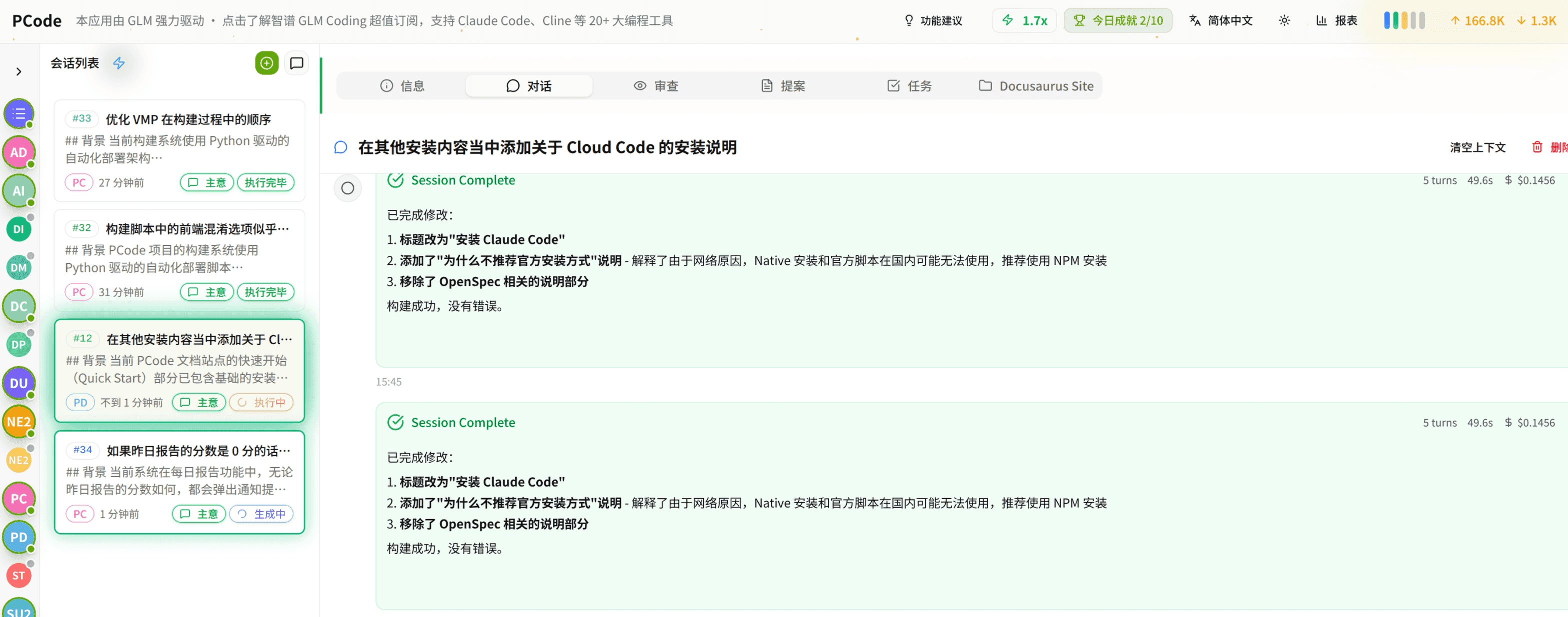
- SmartStructured workflows turn intent into an executable path from idea to shipped change.
- EfficientMulti-agent workflows keep research, implementation, and review moving in parallel.
- FunHero Dungeon interfaces make long coding sessions visual, collaborative, and rewarding.