OpenCode Integration
Status: Generally available. Audience: Operators wiring OpenCode to an OmniRoute deployment. Source of truth (config schema):
src/shared/services/opencodeConfig.tsSource of truth (npm package):@omniroute/opencode-provider/(publishable workspace)
OpenCode is an agentic CLI/desktop AI client. It reads its provider catalog from ~/.config/opencode/opencode.json (or opencode.jsonc) and follows the schema at https://opencode.ai/config.json. OmniRoute exposes itself to OpenCode as one of those providers — every request flows through OmniRoute’s standard OpenAI-compatible /v1 surface, so OpenCode automatically benefits from Auto-Combo routing, circuit breakers, key policies, observability, etc.
There are two supported integration paths. Pick one — they generate the same config.
Path 1 — CLI generator (no npm install)
Section titled “Path 1 — CLI generator (no npm install)”Recommended for end users. Ships with OmniRoute. Writes opencode.json in place.
# After installing OmniRoute (npm i -g @omniroute/cli or local clone)omniroute config opencode \ --base-url http://localhost:20128 \ --api-key "$OMNIROUTE_API_KEY"Behind the scenes the CLI calls mergeOpenCodeConfigText() (src/shared/services/opencodeConfig.ts:104), so an existing opencode.json keeps its other providers and comments. The OmniRoute entry is added/replaced atomically.
Resulting file (default model catalog):
{ "$schema": "https://opencode.ai/config.json", "provider": { "omniroute": { "npm": "@ai-sdk/openai-compatible", "name": "OmniRoute", "options": { "baseURL": "http://localhost:20128/v1", "apiKey": "<your-key>", }, "models": { "claude-opus-4-5-thinking": { "name": "claude-opus-4-5-thinking" }, "claude-sonnet-4-5-thinking": { "name": "claude-sonnet-4-5-thinking" }, "gemini-3.1-pro-high": { "name": "gemini-3.1-pro-high" }, "gemini-3-flash": { "name": "gemini-3-flash" }, }, }, },}Path 2 — npm package @omniroute/opencode-provider
Section titled “Path 2 — npm package @omniroute/opencode-provider”Recommended when you’re scripting the config from Node/TS (CI pipelines, monorepos, custom installer flows).
npm install --save-dev @omniroute/opencode-providerimport { writeFileSync } from "node:fs";import { buildOmniRouteOpenCodeConfig } from "@omniroute/opencode-provider";
const config = buildOmniRouteOpenCodeConfig({ baseURL: "http://localhost:20128", apiKey: process.env.OMNIROUTE_API_KEY ?? "sk_omniroute", // Optional: override the model catalog exposed to OpenCode models: ["auto", "claude-opus-4-7", "gpt-5.5"], modelLabels: { auto: "Auto-Combo" },});
writeFileSync("opencode.json", JSON.stringify(config, null, 2));For a non-destructive merge against an existing file, replicate mergeOpenCodeConfigText() from opencodeConfig.ts or call the CLI generator.
See the package README for the full API.
What the runtime actually does
Section titled “What the runtime actually does”Both paths produce the same provider.omniroute.npm: "@ai-sdk/openai-compatible". At runtime, OpenCode loads @ai-sdk/openai-compatible (already a transitive dependency of OpenCode) and configures it with baseURL + apiKey. From there:
OpenCode UI/agent → @ai-sdk/openai-compatible → HTTP POST {baseURL}/chat/completions (OmniRoute OpenAI surface) → OmniRoute /v1/chat/completions handler (open-sse/handlers/chatCore.ts) → combo routing / Auto-Combo / executor → upstream providerThe plugin never touches HTTP. It only emits configuration.
Model catalog defaults
Section titled “Model catalog defaults”export const OMNIROUTE_DEFAULT_OPENCODE_MODELS = [ "claude-opus-4-5-thinking", "claude-sonnet-4-5-thinking", "gemini-3.1-pro-high", "gemini-3-flash",] as const;You can override via models: [...]. Recommended additions:
"auto"— surfaces OmniRoute’s Auto-Combo zero-config router. Lets OpenCode pick “the best available model” without you hard-coding the catalog."<combo-name>"— any combo you’ve defined in the dashboard; OmniRoute resolves it transparently.
URL normalisation
Section titled “URL normalisation”The helper accepts both forms and emits exactly one /v1:
| Input | Output (options.baseURL) |
|---|---|
http://localhost:20128 |
http://localhost:20128/v1 |
http://localhost:20128/ |
http://localhost:20128/v1 |
http://localhost:20128/v1 |
http://localhost:20128/v1 |
http://localhost:20128/v1/// |
http://localhost:20128/v1 |
This deduplication is the most common breakage seen in older configs. If you have an opencode.json from before v3.8.0 that points at /v1/v1/..., re-run the generator or call createOmniRouteProvider again.
Authentication modes
Section titled “Authentication modes”| OmniRoute setting | Recommended apiKey value |
|---|---|
REQUIRE_API_KEY=false (default for local) |
sk_omniroute (literal placeholder) |
REQUIRE_API_KEY=true |
A real per-user API key from Dashboard → API Keys. |
For Anthropic-style clients that send x-api-key + anthropic-version, OmniRoute’s extractApiKey also honours the key from x-api-key. OpenCode uses the OpenAI surface, so it’ll always send Authorization: Bearer ${apiKey} — no Anthropic special-case applies here.
Troubleshooting
Section titled “Troubleshooting”| Symptom | Cause | Fix |
|---|---|---|
404 on every request with URL containing /v1/v1/ |
Stale config from pre-v3.8 plugin that double-suffixed /v1. |
Regenerate via Path 1 or 2. |
401 Invalid API key |
OmniRoute has REQUIRE_API_KEY=true and the key is unknown. |
Create the key in the dashboard, or set REQUIRE_API_KEY=false (local only) and use sk_omniroute. |
| Model list empty in OpenCode UI | All 4 default models are hidden in OmniRoute’s provider visibility. | Pass models: ["auto", ...] to surface ones you’ve enabled. |
OpenCode 500 with cannot read property 'models' |
Older OpenCode (< 0.1.x) didn’t accept inline models. |
Upgrade OpenCode to a version that follows the v1 schema (opencode.ai/config.json). |
See also
Section titled “See also”- API reference — full OmniRoute REST surface
- Auto-Combo — what
model: "auto"means @omniroute/opencode-providerREADME- Source:
src/shared/services/opencodeConfig.ts,src/lib/cli-helper/config-generator/opencode.ts,@omniroute/opencode-provider/src/index.ts
HagiCode
HagiCode is an agentic coding workspace: structured workflows, multi-agent execution, and Hero Dungeon views turn ideas into shipped software.
Turn ideas into polished, usable software with a smarter, faster, and more enjoyable agentic coding workflow.
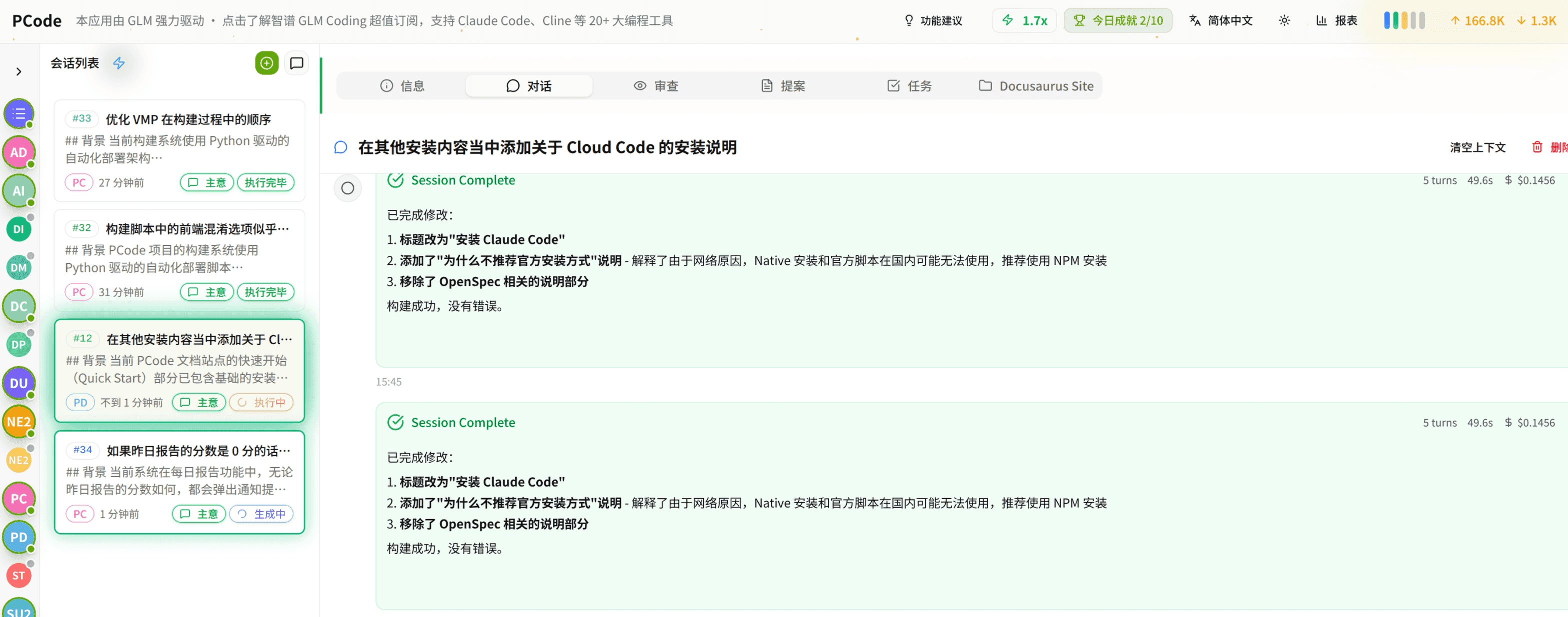
- SmartStructured workflows turn intent into an executable path from idea to shipped change.
- EfficientMulti-agent workflows keep research, implementation, and review moving in parallel.
- FunHero Dungeon interfaces make long coding sessions visual, collaborative, and rewarding.