Claude Code CLI — Configuration with OmniRoute
Point the Claude Code CLI (claude) at OmniRoute — local or a remote VPS —
with per-model profiles, mirroring the Codex setup.
Quick start
Section titled “Quick start”# Launch Claude Code against a local OmniRoute (auto-detects the active context)omniroute launch
# Against a remote OmniRoute (after `omniroute connect <host>`, this is automatic)omniroute launch --remote http://192.168.0.15:20128 --api-key oma_live_xxx
# Generate per-model profiles, then launch oneomniroute setup-claude # writes ~/.claude/profiles/<name>/settings.jsonomniroute launch --profile glm52 # Claude Code using glm/glm-5.2 via OmniRouteHow Claude Code connects to a gateway
Section titled “How Claude Code connects to a gateway”Claude Code talks the Anthropic Messages API and is pointed at a custom
endpoint with environment variables (it has no --base-url flag):
| Variable | Purpose |
|---|---|
ANTHROPIC_BASE_URL |
Gateway root URL (Claude Code appends /v1/messages). No /v1 suffix. |
ANTHROPIC_AUTH_TOKEN |
Sent as Authorization: Bearer … — use your OmniRoute access token / API key |
ANTHROPIC_API_KEY |
Alternative: sent as x-api-key. If both set, ANTHROPIC_AUTH_TOKEN wins |
ANTHROPIC_MODEL |
Force a specific model (overrides the /model picker default) |
CLAUDE_CODE_ENABLE_GATEWAY_MODEL_DISCOVERY |
1 → the native /model picker lists claude*/anthropic* models from /v1/models |
CLAUDE_CODE_MAX_OUTPUT_TOKENS |
Cap output tokens per response (e.g. 65536) |
CLAUDE_CODE_AUTO_COMPACT_WINDOW |
Token threshold for auto-compaction |
Env vars are read once at startup — restart Claude Code after changing them.
omniroute launch sets all of these for you: it resolves the base URL + token
from the active context (so omniroute connect <vps> then omniroute launch
just works), health-checks the server, and execs claude.
Discovery aliases — surface non-Claude models in the /model picker
Section titled “Discovery aliases — surface non-Claude models in the /model picker”Claude Code’s gateway model discovery only lists ids that begin with claude
or anthropic, so with CLAUDE_CODE_ENABLE_GATEWAY_MODEL_DISCOVERY=1 the native
/model picker normally shows only OmniRoute’s Claude/Anthropic models — a
kimi/kimi-k2.6 or glm/glm-5.2 never appears, even though it routes fine.
OmniRoute can mirror any enabled model (and combo) under a claude/… id so it
passes that filter and shows up in the picker:
kimi/kimi-k2.6 → claude/kimi/kimi-k2.6 "Kimi K2.6 (OmniRoute)"glm/glm-5.2 → claude/glm/glm-5.2 "GLM 5.2 (OmniRoute)"<combo "custo-otimizado"> → claude/combo/custo-otimizadoWhen you pick one of these in Claude Code, OmniRoute strips the claude/ wrapper
back to the real id before routing — a genuine claude/<real-claude-model> id
(the actual Claude OAuth provider) is always left untouched.
This is off by default and controlled by a three-level gate (most specific wins), so a plain OmniRoute never doubles its catalog for clients that don’t use Claude Code:
| Level | Where |
|---|---|
| Model | Provider detail page → per-model “Expose in Claude Code” toggle |
| Provider | Provider detail page → provider-level toggle (covers all its models) |
| Global | Settings → Feature Flags → EXPOSE_CC_DISCOVERY_ALIASES (default off) |
The EXPOSE_CC_DISCOVERY_ALIASES environment variable forces the global level on
and takes precedence over the dashboard override (the Feature Flags screen shows
an “active via environment variable” note when it does). Per-provider and
per-model toggles refine from there — e.g. global off + Kimi provider on exposes
only Kimi’s models.
⚠️ Window mismatch on non-Claude models. Claude Code assumes a 200K context window for any id it doesn’t recognize (it can’t read a real window from
/v1/models). For a model with a larger window (e.g. Kimi K2’s 256K), setCLAUDE_CODE_AUTO_COMPACT_WINDOWto a value below the model’s real window so auto-compaction doesn’t fire prematurely. The generated profiles above already do this per model.
Onboarding block on the dashboard
Section titled “Onboarding block on the dashboard”The Claude tool card (Dashboard → CLI Code) renders the exact settings.json fragment
for this instance, next to the discovery-alias info button, with a copy button:
{ "env": { "ANTHROPIC_BASE_URL": "http://<your OmniRoute>:20128", "ANTHROPIC_AUTH_TOKEN": "<your OmniRoute API key>", "CLAUDE_CODE_ENABLE_GATEWAY_MODEL_DISCOVERY": "1", },}The base URL is the one resolved by the card (including a custom override you typed), already
normalized — no /v1 suffix, no trailing slash. The key is never rendered: the block ships a
placeholder, so a screenshot or a pasted snippet cannot leak one. Paste your key over it.
Add CLAUDE_CODE_AUTO_COMPACT_WINDOW under the same env block for any model whose real
context window is not 200K — Claude Code assumes 200K for every id it does not recognize, so
auto-compaction otherwise fires at the wrong point (see the warning in the previous section).
The snippet builder accepts that value too, so a caller that knows the target model’s window
can emit it directly.
Source: src/shared/services/claudeCliConfig.ts::buildClaudeDiscoverySettingsSnippet (pure
builder, unit-tested) rendered by ClaudeGatewayOnboardingBlock.
Profiles (CLAUDE_CONFIG_DIR)
Section titled “Profiles (CLAUDE_CONFIG_DIR)”Claude Code has no native profile files (unlike Codex’s ~/.codex/<name>.config.toml).
The idiomatic mechanism is CLAUDE_CONFIG_DIR — a separate config directory per
profile, each with its own settings.json, credentials, history and cache.
omniroute setup-claude fetches the live /v1/models catalog and writes one
profile per model at ~/.claude/profiles/<name>/settings.json, reusing the
same names as setup-codex (glm52, kimi-k27, deepseek-pro, …):
{ "$schema": "https://json.schemastore.org/claude-code-settings.json", "model": "glm/glm-5.2", "effortLevel": "xhigh", "env": { "ANTHROPIC_BASE_URL": "http://192.168.0.15:20128", "ANTHROPIC_MODEL": "glm/glm-5.2", "CLAUDE_CODE_ENABLE_GATEWAY_MODEL_DISCOVERY": "1", "CLAUDE_CODE_AUTO_COMPACT_WINDOW": "190000", },}The auth token is never written to the profile. Launch with
omniroute launch --profile <name>(it injectsANTHROPIC_AUTH_TOKENfrom the active context), or exportANTHROPIC_AUTH_TOKENyourself and runCLAUDE_CONFIG_DIR=~/.claude/profiles/<name> claude.
Auto-sync after model discovery (opt-in). OmniRoute can regenerate these same
~/.claude/profiles/<name>/settings.json files automatically whenever a provider model
sync changes the live catalog — so new/renamed models get profiles without re-running the
command. It is off by default: toggle it from the CLI Code dashboard (“CLI profile
auto-sync” → Claude Code), or set OMNIROUTE_AUTO_SYNC_CLAUDE_PROFILES=true (it also honors
CLI_ALLOW_CONFIG_WRITES, on by default). When enabled it only writes profile files; it never
changes your active/default Claude config, auth, or the ~/.claude/settings.json.
Generating + using profiles
Section titled “Generating + using profiles”# Local OmniRouteomniroute setup-claude
# Remote VPS (bakes the VPS URL into every profile)omniroute setup-claude --remote http://192.168.0.15:20128 --api-key oma_live_xxx
# Only some providersomniroute setup-claude --only glm,kimi
# Preview without writingomniroute setup-claude --dry-run
# Launch a profileomniroute launch --profile kimi-k27Model tiers (optional)
Section titled “Model tiers (optional)”Claude Code routes to capability tiers. Map each to an OmniRoute model via env / settings if you want different providers per tier:
export ANTHROPIC_DEFAULT_OPUS_MODEL="glm/glm-5.2"export ANTHROPIC_DEFAULT_SONNET_MODEL="kmc/kimi-k2.6"export ANTHROPIC_DEFAULT_HAIKU_MODEL="glm/glm-4.7-flash"Otherwise a single ANTHROPIC_MODEL (what profiles set) is used for everything.
Remote mode
Section titled “Remote mode”Once you’ve run omniroute connect <host> (see
Remote Mode), omniroute launch and omniroute setup-claude
automatically target that remote server and use its scoped access token — no
extra flags needed. Override per-invocation with --remote / --api-key.
Troubleshooting
Section titled “Troubleshooting”Claude Code ignores the gateway — confirm ANTHROPIC_BASE_URL has no
/v1 and restart claude (env is read once at startup). omniroute launch
handles this for you.
/model picker is empty / missing gateway models — needs Claude Code
v2.1.219+ and CLAUDE_CODE_ENABLE_GATEWAY_MODEL_DISCOVERY=1. Only claude* /
anthropic* model IDs appear in the picker; force any other model with
ANTHROPIC_MODEL=<id> (this is what profiles do).
400 Ambiguous model 'claude-…' — Claude Code always sends unprefixed
model IDs (e.g. claude-opus-4-8), so when both the Claude Code (cc/…) and
Claude (claude/…) providers are connected the bare id matches two routes and
OmniRoute refuses to guess. Fix it either way: pin a prefixed id with
ANTHROPIC_MODEL=cc/claude-opus-4-8, or enable Prefer Claude Code for
unprefixed Claude models — the toggle on the Claude provider page, or
OMNIROUTE_PREFER_CLAUDE_CODE_FOR_UNPREFIXED_CLAUDE_MODELS=true (default off;
see Environment) — which routes bare claude-*
IDs to Claude Code instead. Explicit provider prefixes always win.
Auth errors — the profile holds no token. Use omniroute launch --profile
(injects it) or export ANTHROPIC_AUTH_TOKEN.
Profiles don’t isolate — each profile is a distinct CLAUDE_CONFIG_DIR;
verify echo $CLAUDE_CONFIG_DIR inside the session points at
~/.claude/profiles/<name>.
HagiCode
HagiCode is an agentic coding workspace: structured workflows, multi-agent execution, and Hero Dungeon views turn ideas into shipped software.
Turn ideas into polished, usable software with a smarter, faster, and more enjoyable agentic coding workflow.
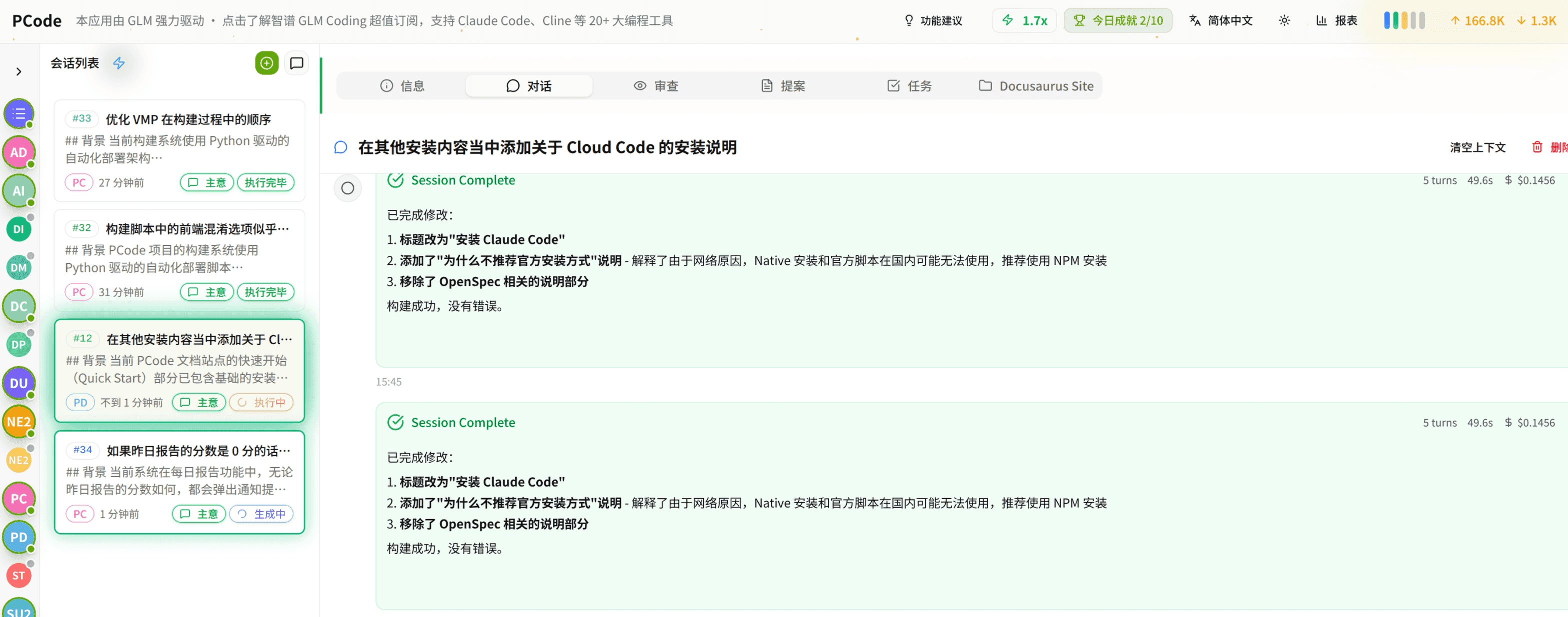
- SmartStructured workflows turn intent into an executable path from idea to shipped change.
- EfficientMulti-agent workflows keep research, implementation, and review moving in parallel.
- FunHero Dungeon interfaces make long coding sessions visual, collaborative, and rewarding.