Progressive Web App (PWA) Guide
OmniRoute ships as a fully installable Progressive Web App. When you access the dashboard from any mobile browser — Android (Chrome) or iOS (Safari) — you can “Add to Home Screen” and get a native app-like experience with no app store required.
What Is a PWA?
Section titled “What Is a PWA?”A Progressive Web App turns the OmniRoute web dashboard into something that looks and feels like a native mobile app. Once installed, it:
- Launches from your home screen with its own icon
- Opens fullscreen — no browser address bar or tab UI
- Works offline with a dedicated connectivity page
- Caches static assets for faster loading
- Supports both portrait and landscape orientations
Installation
Section titled “Installation”Android (Chrome)
Section titled “Android (Chrome)”- Open the OmniRoute dashboard in Chrome:
http://YOUR_IP:20128 - Chrome will show an “Add OmniRoute to Home screen” banner automatically, or:
- Tap the ⋮ menu (three dots) → “Add to Home screen” or “Install app”
- Confirm the prompt
- OmniRoute appears on your home screen as a standalone app
iOS (Safari)
Section titled “iOS (Safari)”- Open the OmniRoute dashboard in Safari:
http://YOUR_IP:20128 - Tap the Share button (box with arrow)
- Scroll down and tap “Add to Home Screen”
- Name it (defaults to “OmniRoute”) and tap Add
- OmniRoute appears on your home screen with the app icon
Desktop (Chrome / Edge)
Section titled “Desktop (Chrome / Edge)”- Open the OmniRoute dashboard
- Click the install icon in the address bar (or ⋮ → “Install OmniRoute…”)
- Confirm the prompt
- OmniRoute opens as a standalone window — no tabs, no address bar
Features
Section titled “Features”Fullscreen Experience
Section titled “Fullscreen Experience”The manifest is configured with display: "fullscreen", which means the installed app uses the entire screen — no browser chrome, no status bar overlap. This makes the dashboard feel truly native.
Offline Support
Section titled “Offline Support”OmniRoute includes a service worker (sw.js) that provides intelligent caching:
| Asset Type | Strategy | Behavior |
|---|---|---|
| App Shell | Cache-first | /, /offline, manifest, and icons are pre-cached on install |
| Static assets (CSS, JS, images, fonts) | Network-first with cache fallback | Fetches fresh from the network; falls back to cache if offline |
Next.js bundles (/_next/) |
Network-first with cache update | Fetches from network and updates cache; serves cached version if offline |
| Navigation requests | Bypass (never intercepted) | Browser owns HTTP/3→HTTP/2 fallback; a dead QUIC socket must not become Response.error() |
API / dashboard routes (/api/, /a2a, /dashboard) |
Bypass (never cached) | Always goes directly to the server — never intercepted by the service worker |
Offline Page
Section titled “Offline Page”When the network is unavailable and a user navigates to a new page, the service worker serves a dedicated /offline page that:
- Displays a clear “Connectivity Issue” message
- Shows a live online/offline status indicator that updates in real time
- Provides a “Retry Connection” button to reload when connectivity returns
- Links to the Status Page for diagnostics
App Icons
Section titled “App Icons”OmniRoute provides icons optimized for each platform:
| File | Size | Used By |
|---|---|---|
icon-512.png |
512×512 | Android install prompt, splash screen |
apple-touch-icon.png |
180×180 | iOS home screen icon |
icon-192.svg |
192×192 (vector) | Android adaptive icon |
apple-touch-icon.svg |
180×180 (vector) | Apple fallback |
favicon.svg |
Vector | Browser tabs |
favicon.ico |
Multi-size | Legacy browsers |
Automatic Registration
Section titled “Automatic Registration”The service worker is registered automatically via the <PwaRegister /> component in the root layout. No user action is needed — the app becomes installable as soon as the browser detects the valid manifest and service worker.
Technical Architecture
Section titled “Technical Architecture”Web App Manifest (manifest.webmanifest)
Section titled “Web App Manifest (manifest.webmanifest)”Generated by Next.js via src/app/manifest.ts:
{ "name": "OmniRoute", "short_name": "OmniRoute", "description": "OmniRoute is an AI gateway for multi-provider LLMs. One endpoint for all your AI providers.", "start_url": "/", "scope": "/", "display": "fullscreen", "orientation": "any", "background_color": "#0b0f1a", "theme_color": "#0b0f1a", "icons": [ { "src": "/icon-512.png", "sizes": "512x512", "type": "image/png", "purpose": "any maskable" }, { "src": "/apple-touch-icon.png", "sizes": "180x180", "type": "image/png" } ]}Service Worker (public/sw.js)
Section titled “Service Worker (public/sw.js)”A vanilla service worker (no framework dependencies) with:
- Install phase: Pre-caches the app shell (root, offline page, manifest, icons)
- Activate phase: Cleans up old cache versions and claims all clients
- Fetch phase: Intelligent routing based on request type (navigation, static asset, API)
- Cache versioning:
omniroute-pwa-v3— bump this to force a fresh cache on update
Layout Metadata (src/app/layout.tsx)
Section titled “Layout Metadata (src/app/layout.tsx)”The root layout provides all the meta tags required for PWA compliance:
manifestlink to/manifest.webmanifestapple-web-app-capable: truefor iOS standalone modeapple-web-app-status-bar-style: black-translucentmobile-web-app-capable: yesfor Android Chrometheme-color: #0b0f1aviewport-fit: coverfor edge-to-edge rendering
Component: PwaRegister
Section titled “Component: PwaRegister”Located at src/shared/components/PwaRegister.tsx, this client component:
- Runs on mount (client-side only)
- Checks for
serviceWorkersupport in the browser - Registers
/sw.jssilently (errors are swallowed to avoid blocking the app) - Renders nothing (
return null) — it’s a side-effect-only component
Use With Termux (Android)
Section titled “Use With Termux (Android)”When running OmniRoute on Android via Termux, the PWA works seamlessly:
- Start OmniRoute in Termux:
npx omniroute - Open Chrome on the same phone:
http://localhost:20128 - Install the PWA via “Add to Home Screen”
- The PWA connects to the local Termux server — everything runs on-device
This combination means your Android phone is both the server (Termux) and the client (PWA) — a complete self-contained AI gateway.
Use From Other Devices
Section titled “Use From Other Devices”Install the PWA on any device that has browser access to your OmniRoute server:
- Another phone/tablet: Navigate to
http://PHONE_IP:20128and install the PWA - Laptop: Open Chrome/Edge and install it as a desktop PWA
- Smart TV with browser: Access the dashboard fullscreen
Customization
Section titled “Customization”Instance Name
Section titled “Instance Name”The PWA title respects the Instance Name setting from Dashboard → Settings. If you rename your instance to “My AI Gateway”, the installed PWA will show that name.
Custom Favicon
Section titled “Custom Favicon”If you upload a custom favicon via Dashboard → Settings, the PWA icon on desktop will reflect the custom icon. Mobile home screen icons use the pre-built icon-512.png and apple-touch-icon.png files.
Limitations
Section titled “Limitations”- No push notifications — The service worker does not implement the Push API. Notifications are handled by the Electron app instead.
- No background sync — Offline actions are not queued for replay. The PWA is primarily a dashboard viewer.
- iOS restrictions — Safari on iOS does not support all PWA features (e.g., install prompts are manual, and background service workers are limited).
- Cache size — The service worker caches static assets only. Large response payloads from
/api/routes are never cached. - Custom icons on mobile — Changing the favicon in settings does not update the home screen icon on mobile (this requires regenerating the PWA icons).
Files Reference
Section titled “Files Reference”| File | Purpose |
|---|---|
src/app/manifest.ts |
Next.js manifest route (generates manifest.webmanifest) |
public/sw.js |
Service worker with caching logic |
src/shared/components/PwaRegister.tsx |
Client component that registers the service worker |
src/app/offline/page.tsx |
Offline fallback page with live status indicator |
src/app/layout.tsx |
Root layout with PWA metadata (apple-web-app, theme-color, etc.) |
public/icon-512.png |
512×512 PNG icon (Android, splash screen) |
public/apple-touch-icon.png |
180×180 PNG icon (iOS home screen) |
public/icon-192.svg |
192×192 SVG icon (Android adaptive) |
public/apple-touch-icon.svg |
180×180 SVG icon (Apple fallback) |
HagiCode
HagiCode is an agentic coding workspace: structured workflows, multi-agent execution, and Hero Dungeon views turn ideas into shipped software.
Turn ideas into polished, usable software with a smarter, faster, and more enjoyable agentic coding workflow.
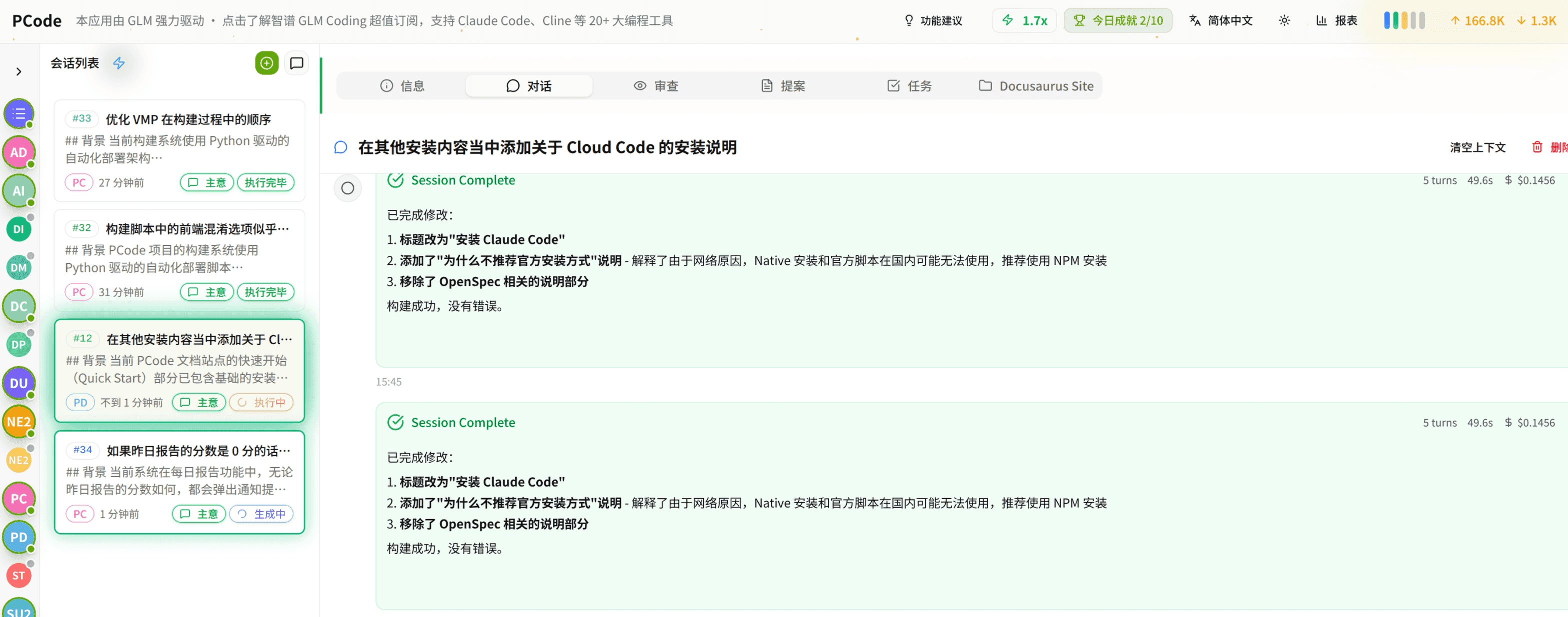
- SmartStructured workflows turn intent into an executable path from idea to shipped change.
- EfficientMulti-agent workflows keep research, implementation, and review moving in parallel.
- FunHero Dungeon interfaces make long coding sessions visual, collaborative, and rewarding.