Free Tiers Guide: Understand and Combine Free AI Access
TL;DR: OmniRoute registers 357 provider IDs, with 152 provider-catalog entries marked
hasFree. The stricter audited free-model catalog covers 35 recurring pool keys / 482 entries (475 active + 7 discontinued). Connect several suitable providers for broader fallback capacity; every quota, approval rule, privacy policy, and paid-overage condition still applies.
What Are Free Tiers?
Section titled “What Are Free Tiers?”Many AI providers offer some form of free access. Depending on the provider, that may mean a no-auth endpoint, recurring quota, rate-limited uncapped access, a signup grant, manual approval, or a temporary promotion. Some options require an account, API key, credit card, KYC, or acceptance of provider-specific terms.
OmniRoute aggregates these free tiers into one endpoint. Instead of signing up for 10 different services, you connect them all to OmniRoute and use model: "auto" to automatically pick the best free option for each request.
Representative Free-Access Providers
Section titled “Representative Free-Access Providers”Recurring, Keyless, or Uncapped Access
Section titled “Recurring, Keyless, or Uncapped Access”These providers have a recurring, keyless, or uncapped free-access path in the audited catalog. “Uncapped” means no published token cap; rate, concurrency, account, regional, and policy limits can still apply:
| Provider | Models | Quota | How to Connect |
|---|---|---|---|
| Kiro AI | Claude Sonnet 4.5, Haiku 4.5, DeepSeek V3.2, and others | Audited catalog estimates a 25K-token shared monthly pool | OAuth/account flow; ToS flagged avoid in the catalog |
| OpenCode Free | Current *-free model set in the provider registry |
Keyless; no published token cap | No provider credential; ToS flagged avoid |
| Pollinations | Current keyless model set; some former models are discontinued or key-required | Keyless; no published token cap | No provider credential for the keyless models |
| Logfare | kimi-k3, deepseek-v4-pro, glm-5.2, gpt-5.6-luna, minimax-m3, and more | Free API key (no rate limits, no card); every request is logged for research (opt out at logfare.ai/consent) | Instant key at logfare.ai/register; ToS/privacy at logfare.ai/tos and logfare.ai/privacy |
| Cloudflare AI | Workers AI catalog | Audited pool estimates ~30M tokens/month from published usage units | Cloudflare account and API credentials |
| Gemini | Gemini Flash family | Audited pool estimates ~60M tokens/month | Google AI Studio API key; rate limits apply |
| Groq | Llama, GPT-OSS, and Qwen models | Audited pool estimates ~15M tokens/month | Groq API key; rate limits apply |
| Cerebras | GLM 4.7 and GPT-OSS 120B | Audited pool estimates ~30M tokens/month | Cerebras API key; rate limits apply |
Signup Grants and Provider-Specific Credits
Section titled “Signup Grants and Provider-Specific Credits”These providers give you free credits when you sign up:
| Provider | Free Credits | Models | How to Get |
|---|---|---|---|
| DeepSeek | 5M free tokens | DeepSeek V4 | Sign up at platform.deepseek.com |
| LongCat | 10M-token one-time grant | LongCat 2.0 | API key + KYC; pay-as-you-go after the grant |
| Vertex AI | $300 signup credit represented as ~300M tokens in the budget model | Gemini and partner models | Google Cloud account; billing and eligibility rules apply |
Other Limited Access
Section titled “Other Limited Access”These providers have free tiers with specific limits:
| Provider | Free Limit | Models | Best For |
|---|---|---|---|
| GitHub Models | Audited shared pool estimates ~18M tokens/month | Broad model evaluation | |
| Hugging Face | Small recurring monthly pool | Experiments and model variety | |
| OpenRouter free models | Shared request-limited pool; optional one-time top-up increases the recurring allowance | Broad fallback catalog | |
| AI Horde | Keyless community capacity; availability varies | Opportunistic distributed inference |
How to Stack Free Tiers
Section titled “How to Stack Free Tiers”The magic of OmniRoute is stacking free tiers. Instead of relying on one provider, you connect multiple free providers and let OmniRoute automatically pick the best one for each request.
Example: Broader Free-Tier Coverage
Section titled “Example: Broader Free-Tier Coverage”Connect several providers to reduce dependence on any single quota:
- Gemini — recurring API-key quota
- Groq — recurring API-key quota
- Pollinations — keyless, rate-limited access
- LongCat — one-time signup grant (requires KYC)
Then use model: "auto" and OmniRoute will:
- Try the highest-ranked eligible connection first
- If its quota or health check fails → try the next configured provider
- If the keyless provider is unavailable → continue through the remaining targets
- If all fail → use LongCat as backup
Result: broader free-tier coverage with automatic fallback — not a guarantee of unlimited capacity.
How to Connect Free Providers
Section titled “How to Connect Free Providers”Step 1: Open the Dashboard
Section titled “Step 1: Open the Dashboard”Go to http://localhost:20128 in your browser.
Step 2: Go to Providers
Section titled “Step 2: Go to Providers”Click Providers in the sidebar.
Step 3: Click Add Provider
Section titled “Step 3: Click Add Provider”Click the + Add Provider button.
Step 4: Select a Free Provider
Section titled “Step 4: Select a Free Provider”Browse the catalog and inspect each provider’s current hasFree, auth, quota, privacy,
and ToS metadata. The provider card and the
Free Tiers Reference distinguish recurring pools,
uncapped/keyless access, signup credits, discontinued entries, and higher-risk sources.
Step 5: Click Connect
Section titled “Step 5: Click Connect”For a NOAUTH provider, no credential is required. OAuth and API-key providers must be
connected through their documented account flow.
Step 6: Repeat
Section titled “Step 6: Repeat”Connect several providers whose terms and privacy model fit your use case.
Reading the Catalog Correctly
Section titled “Reading the Catalog Correctly”NOAUTHmeans OmniRoute does not ask you for a provider credential; it does not guarantee uptime, privacy, or unlimited capacity.hasFreeis discovery metadata. It can represent a recurring quota, keyless access, signup credit, approval program, or promotion.recurring-uncappedmeans no published token ceiling was available; rate and concurrency limits still apply.one-time-initialdoes not recur after the signup grant is consumed.tos: avoidis a warning to review provider terms and account risk before use.- Entries marked
discontinuedremain historical evidence and must not be presented as currently free.
How OmniRoute Makes Free Tiers Better
Section titled “How OmniRoute Makes Free Tiers Better”1. Automatic Fallback
Section titled “1. Automatic Fallback”If one free provider is busy or down, OmniRoute automatically tries the next one. You don’t need to do anything.
2. Smart Routing
Section titled “2. Smart Routing”OmniRoute picks the best free provider for each request based on:
- Speed — Which provider is fastest right now?
- Quality — Which provider is best for this task?
- Capacity — Which provider has quota remaining?
3. Token Savings
Section titled “3. Token Savings”OmniRoute’s compression pipeline can reduce eligible prompt and tool-output tokens. The actual savings depend on content, selected engines, provider accounting, and fidelity settings; compression does not multiply every provider quota by a fixed amount.
4. Multi-Account Support
Section titled “4. Multi-Account Support”If provider terms permit multiple accounts or credentials, OmniRoute can treat each connection as a separate routing candidate. Do not create extra accounts to evade a provider’s quota or access policy.
Free Tier Math
Section titled “Free Tier Math”The live, pool-deduplicated catalog currently reports:
| Metric | Current audited value | Interpretation |
|---|---|---|
| Recurring quantified grant | ~1.62B tokens/month | Shared pools counted once; excludes uncapped providers from the sum |
| First month with signup grants | ~2.22B tokens | Recurring total plus one-time and recurring credits |
| Audited free-model inventory | 35 recurring pool keys / 482 catalog entries | 475 active + 7 discontinued; distinct from the 357-provider catalog |
| Recurring/keyless free-forever providers represented | 53 | Unique providers across recurring daily/monthly/credit/uncapped and keyless catalog types, eligibility-gated rows excluded |
Provider catalog entries marked hasFree |
152 / 357 | Broader provider metadata; not all have a quantifiable recurring quota |
These values are computed from open-sse/config/freeModelCatalog.ts; see the
Free Tiers Reference for pool deduplication, ToS flags,
discontinued entries, and signup-credit methodology.
Common Questions
Section titled “Common Questions”“Is this really free?”
Section titled ““Is this really free?””The catalog records provider-published terms and project research, but offers can change. Verify the provider’s current pricing, quota, privacy policy, and eligibility before use.
“Will the free tier run out?”
Section titled ““Will the free tier run out?””Every provider can rate-limit, change models, suspend access, or go offline. Multiple connections improve fallback coverage but do not guarantee an available free route.
“Can I use free providers for production?”
Section titled ““Can I use free providers for production?””Only if the provider’s SLA, data handling, limits, and terms meet your production requirements. Critical workloads should have monitored, contractually suitable fallback.
“What’s the catch?”
Section titled ““What’s the catch?””Tradeoffs may include strict limits, waitlists, KYC, credit-card verification, training on prompts, weaker privacy, no SLA, model churn, geographic restrictions, paid overage, or account-policy risk. OmniRoute surfaces the available metadata; you choose what to enable.
“How do I get more free quota?”
Section titled ““How do I get more free quota?””- Connect more free providers
- Enable appropriate compression engines and measure savings for your workload
- Use
auto/cheapto prioritize free/cheap providers - Add additional permitted providers or credentials without violating provider terms
“Do free providers have worse quality?”
Section titled ““Do free providers have worse quality?””Not necessarily. Some providers expose the same model families available through paid routes, but limits, latency, privacy, reliability, and model versions can differ. Use the Free Provider Rankings page as a quality signal and verify the actual model served.
What’s Next?
Section titled “What’s Next?”- Auto-Combo Guide — Let OmniRoute pick the best AI for you
- Providers Guide — Connect more providers
- Troubleshooting — Fix common issues
- Free Tiers Reference — Full list of free tiers
HagiCode
HagiCode is an agentic coding workspace: structured workflows, multi-agent execution, and Hero Dungeon views turn ideas into shipped software.
Turn ideas into polished, usable software with a smarter, faster, and more enjoyable agentic coding workflow.
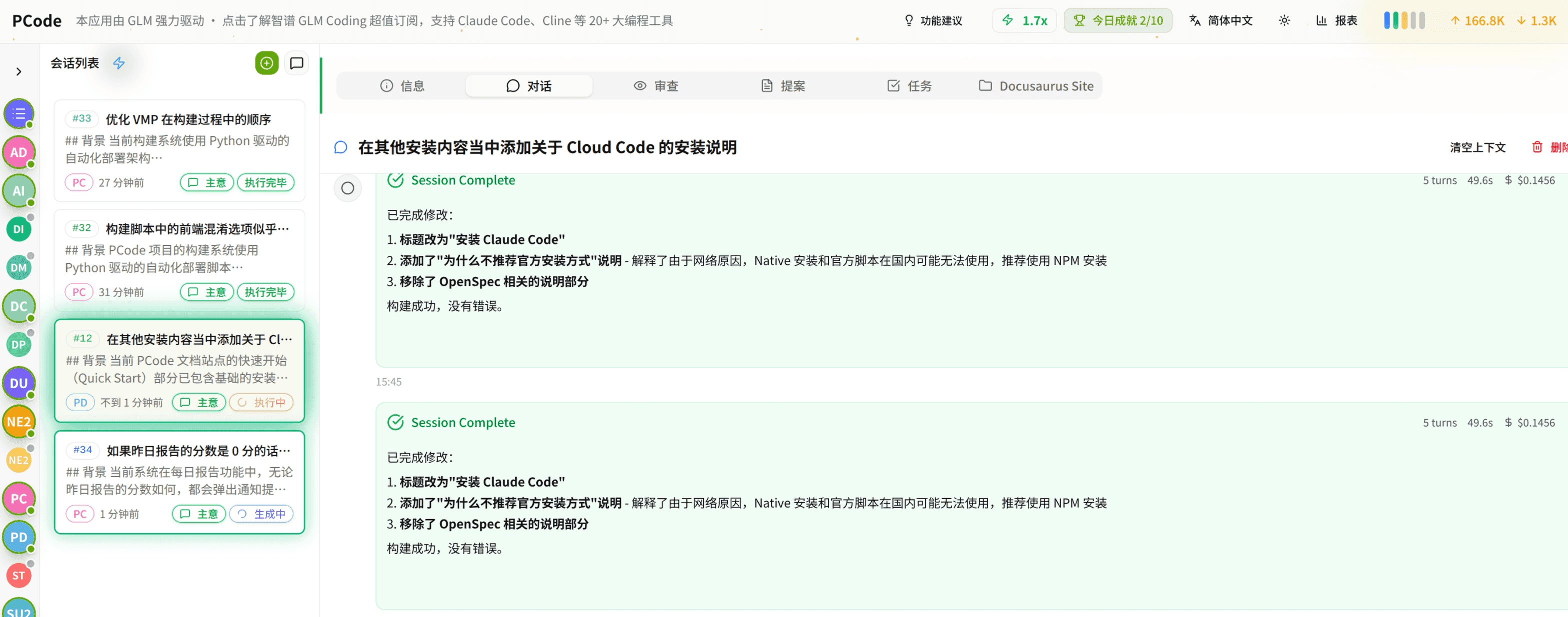
- SmartStructured workflows turn intent into an executable path from idea to shipped change.
- EfficientMulti-agent workflows keep research, implementation, and review moving in parallel.
- FunHero Dungeon interfaces make long coding sessions visual, collaborative, and rewarding.