OmniRoute Tiers — User Guide
OmniRoute organizes the 352 supported providers into 3 economic tiers. Each request travels through them in order until one returns successfully — you get the cheapest viable response without ever writing fallback code.
Tier 1 — Subscription
Section titled “Tier 1 — Subscription”Providers you already pay for. OmniRoute uses every drop of quota before it expires.
| Provider | Why Tier 1 |
|---|---|
| Claude Code OAuth | Anthropic Pro/Team — flat-rate, often unused |
| OpenAI Codex (ChatGPT subscription) | Plus/Team includes Codex quota |
| GitHub Copilot | Per-seat — quota resets monthly |
| Cursor IDE | Pro plan quota |
| Antigravity / Devin Desktop | Built-in quotas |
Strategy: route here first for every request that fits the model’s
strengths. The quota tracker monitors approaching resets, and the reset-aware
combo strategy prioritizes accordingly. To route Tier 1 first and only step out
to paid tiers as quota runs out, use the auto/thrifty id — or auto/subscription
to stay on plan-included capacity and fail closed instead. See
Subscription-first routing.
Tier 2 — Cheap
Section titled “Tier 2 — Cheap”Pay-per-token providers under $1/1M tokens. Reserved for high-volume work or after Tier 1 quotas hit limits.
| Provider | Price (input/output) | Strengths |
|---|---|---|
| DeepSeek V4 Pro | $0.27 / $1.10 per 1M | Code, reasoning |
| GLM-4.5 | $0.60 / $2.20 per 1M | Long context |
| MiniMax M1 | $0.20 / $1.10 per 1M | Speed |
| Qwen Coder | $0.30 / $1.20 per 1M | Code |
| OpenRouter (price-optimized) | varies | 100+ models, dynamic |
Strategy: combo cost-optimized picks lowest $/token model that meets
the task’s capability filter (vision, JSON mode, tools, max-context).
Tier 3 — Free
Section titled “Tier 3 — Free”Zero-cost providers — free tiers, credit programs, OAuth daily quotas.
| Provider | Free quota / credits |
|---|---|
| Kiro AI | Free Claude tier (generous fair-use) |
| OpenCode Free | No auth, generous rate limits |
| Qoder | Free OAuth |
| Google Vertex AI | $300 new-account credits |
| Amazon Q | Free tier for AWS users |
| Pollinations | Open public API |
| Cloudflare AI | Workers AI free tier |
Strategy: combo auto with budget cap routes here when Tier 1+2 fail
or when useFreeOnly=true is set. Free providers often have weaker
rate limits — circuit breaker recovers them on backoff.
Configuring tiers
Section titled “Configuring tiers”Dashboard → Tiers → assign your providers. Defaults (from tierDefaults.json) are
sensible; edit when you have specific subscriptions to prioritize or providers to exclude.
Auto-Combo’s 16-factor scoring also considers tier. See
docs/routing/AUTO-COMBO.md.
Telemetry
Section titled “Telemetry”Dashboard → Usage shows tokens spent per tier per day. Use this to:
- Confirm Tier 1 is utilized fully (otherwise you’re wasting subscription value)
- Identify which Tier 2 models are picked most (consolidate to 1-2)
- Verify Tier 3 saves money on test/exploration workloads
Common patterns
Section titled “Common patterns”Pure-free workload
Section titled “Pure-free workload”{ "strategy": "auto", "config": { "auto": { "weights": { "costInv": 0.5, "tierPriority": 0.3 } } }}Forces strongly towards Tier 3; only uses Tier 2 if Tier 3 is unavailable.
Subscription-first with cheap fallback
Section titled “Subscription-first with cheap fallback”{ "strategy": "priority", "targets": [ { "provider": "claude-code-oauth", "weight": 1 }, { "provider": "deepseek", "weight": 1 }, { "provider": "kiro", "weight": 1 } ]}Explicit ordered list matching Tier 1 → Tier 2 → Tier 3.
HagiCode
HagiCode is an agentic coding workspace: structured workflows, multi-agent execution, and Hero Dungeon views turn ideas into shipped software.
Turn ideas into polished, usable software with a smarter, faster, and more enjoyable agentic coding workflow.
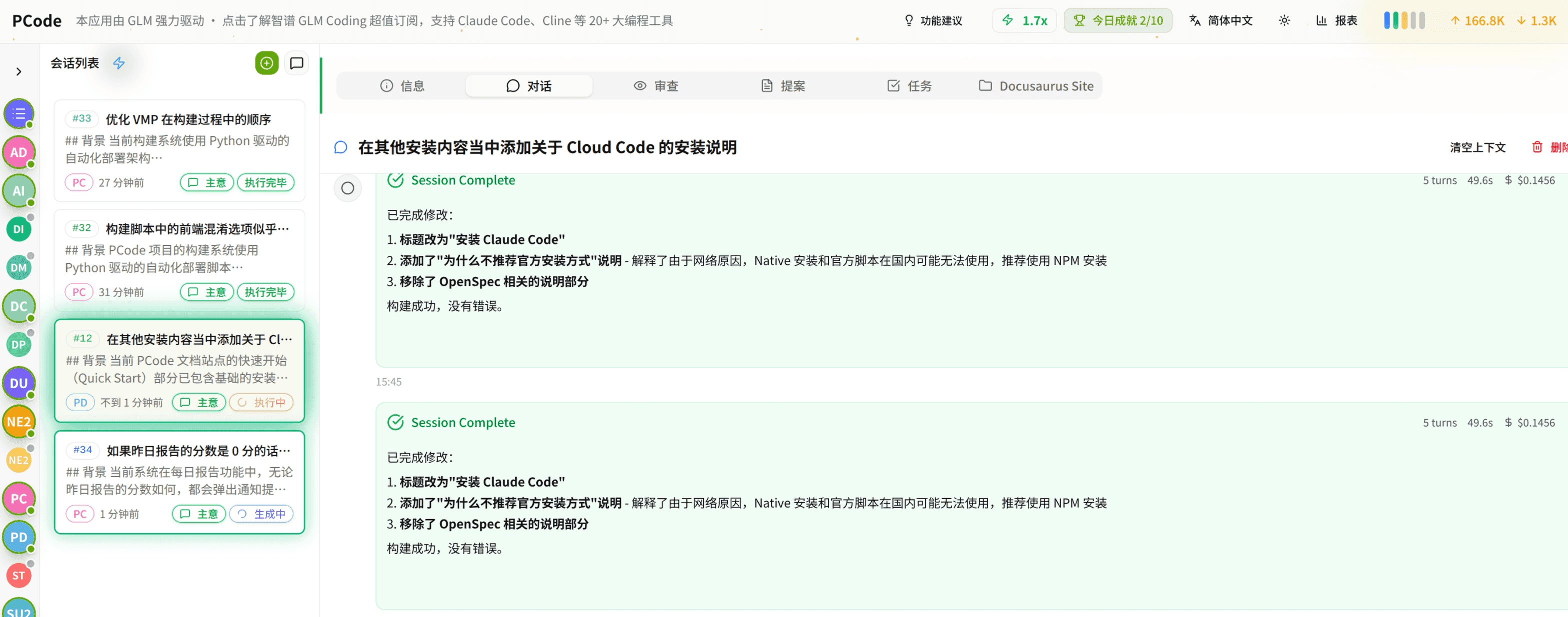
- SmartStructured workflows turn intent into an executable path from idea to shipped change.
- EfficientMulti-agent workflows keep research, implementation, and review moving in parallel.
- FunHero Dungeon interfaces make long coding sessions visual, collaborative, and rewarding.