Providers Guide: Connect AI Models to OmniRoute
TL;DR: A provider is a connection to an AI service (like OpenAI, Anthropic, Google). You need at least one provider to use OmniRoute.
What Is a Provider?
Section titled “What Is a Provider?”Think of a provider like a phone carrier. Just as you need a phone carrier to make calls, you need an AI provider to use AI models. OmniRoute is like a phone that works with all carriers — you can switch between them automatically.
Types of Providers
Section titled “Types of Providers”| Type | What It Is | Examples | Cost |
|---|---|---|---|
| Free | No payment required | Kiro, OpenCode Free, Pollinations | $0 |
| API Key | You need an API key | OpenAI, Anthropic, Google | Pay per use |
| OAuth | Login with your account | Claude Code, GitHub Copilot | Subscription |
| Web Cookie | Uses your browser session | ChatGPT Web (Codex), Gemini Web | $0 (uses your account) |
Web Cookie Providers
Section titled “Web Cookie Providers”See WEB-COOKIE-GUIDE.md for general setup instructions, limitations, troubleshooting, and provider-specific authentication guidance.
Section titled “See WEB-COOKIE-GUIDE.md for general setup instructions, limitations, troubleshooting, and provider-specific authentication guidance.”Quick Start: Connect Your First Provider
Section titled “Quick Start: Connect Your First Provider”Optional first-run free-provider setup
Section titled “Optional first-run free-provider setup”The first-run wizard offers an explicit Set up free providers card. It derives the current eligible list from OmniRoute’s no-auth provider registry, then lets you review and deselect each provider before confirming. OmniRoute shows the provider’s caution notice and a link to its site so you can review third-party terms, privacy, availability, and rate limits first.
This action is optional: finishing the wizard never creates free-provider connections silently. It creates only providers that are still missing, leaves existing customized connections untouched, and reports created, already-configured, and failed providers individually. You can safely retry only the failures after a partial result.
Option A: Free Provider (No Credit Card)
Section titled “Option A: Free Provider (No Credit Card)”- Open the dashboard at
http://localhost:20128 - Go to Providers → Add Provider
- Select one of these free providers:
- Kiro AI — Free Claude models (no auth needed)
- OpenCode Free — Free GPT models (no auth needed)
- Pollinations — Free GPT-5, Claude, Gemini (no key needed)
- LongCat — 10M tokens free (one-time grant, requires account + KYC)
- Cloudflare AI — 50+ models, 10K neurons/day
- MLX Gemma 26B — Local Apple Silicon model (~38.5 tok/s, ~15.9GB RAM)
- MLX Qwen 3.8 27B — Local Apple Silicon model (~9.1 tok/s, ~13.1GB RAM)
- Click Connect
- Done! You now have free AI access.
Option B: API Key Provider (Paid)
Section titled “Option B: API Key Provider (Paid)”- Get an API key from the provider’s website:
- OpenAI: https://platform.openai.com/api-keys
- Anthropic: https://console.anthropic.com/
- Google: https://aistudio.google.com/apikey
- DeepSeek: https://platform.deepseek.com/
- Groq: https://console.groq.com/
- Open the dashboard at
http://localhost:20128 - Go to Providers → Add Provider
- Select your provider
- Paste your API key
- Click Connect
- Done! You now have access to that provider’s models.
Option C: OAuth Provider (Subscription)
Section titled “Option C: OAuth Provider (Subscription)”- Open the dashboard at
http://localhost:20128 - Go to Providers → Add Provider
- Select your provider (e.g., Claude Code, GitHub Copilot)
- Click Connect with OAuth
- Login with your account
- Done! You now have access to your subscription models.
Option D: Local MLX Models (Apple Silicon)
Section titled “Option D: Local MLX Models (Apple Silicon)”For Apple Silicon Macs with unified memory, OmniRoute supports connecting to local MLX models running via mlx-lm.server as regular OpenAI-compatible local providers.
Prerequisites
Section titled “Prerequisites”- Apple Silicon Mac (M1/M2/M3/M4) with 24GB+ unified memory recommended
- uv package manager:
curl -LsSf https://astral.sh/uv/install.sh | sh - mlx-lm:
uv pip install mlx-lm
Quick Start
Section titled “Quick Start”-
Install dependencies:
Terminal window # Install uv if not already installedcurl -LsSf https://astral.sh/uv/install.sh | sh# Install mlx-lmuv pip install mlx-lm -
Start MLX servers manually (in separate terminals):
Terminal window # Terminal 1: Gemma 4 26B A4B IT-QAT (port 11435)uv run mlx_lm.server --model mlx-community/gemma-4-26B-A4B-it-qat-q4_0-mlx-aligned --port 11435 --host 127.0.0.1# Terminal 2: Qwen 3.8 27B MLX Mixed (port 11436)uv run mlx_lm.server --model maglun/Qwen3.8-27B-MLX-Mixed-3.80bpw --port 11436 --host 127.0.0.1 -
Connect in OmniRoute Dashboard:
- Go to Providers → Add Provider
- Select MLX Gemma 26B or MLX Qwen 3.8 27B
- Click Connect (no API key needed)
-
Use with OpenCode:
Terminal window # Configure OpenCode to use OmniRouteopencode config set api.base_url http://localhost:20128/v1opencode config set api.key <your-omniroute-api-key># Use MLX modelsopencode run --model mlx-gemma/gemma-4-26bopencode run --model mlx-qwen/qwen3.8-27b
Memory Management
Section titled “Memory Management”Important: With 24GB unified memory, only one large MLX model can run at a time.
- Gemma 26B: ~15.9GB peak memory
- Qwen 3.8 27B: ~13.1GB peak memory
You must manage this manually:
- Run only one MLX server at a time, or
- Run both on separate machines, or
- Stop one before starting the other
OmniRoute does not automatically manage MLX server processes — it only routes requests to the OpenAI-compatible endpoints you configure.
Tool Calling Support
Section titled “Tool Calling Support”Both models support OpenAI-compatible tool calling. Test with:
curl -X POST http://localhost:20128/v1/chat/completions \ -H "Authorization: Bearer <key>" \ -H "Content-Type: application/json" \ -d '{ "model": "mlx-gemma/gemma-4-26b", "messages": [{"role": "user", "content": "What is 2+2? Use the calculator tool."}], "tools": [{"type": "function", "function": {"name": "calculator", "description": "Calculate", "parameters": {"type": "object", "properties": {"expression": {"type": "string"}}, "required": ["expression"]}}}] }'Troubleshooting
Section titled “Troubleshooting”| Issue | Solution |
|---|---|
| Server won’t start | Check uv run mlx_lm.server --help and verify model IDs |
| Out of memory | Ensure only one model runs; close other apps; check Activity Monitor |
| Connection refused | Verify server is running on correct port (11435/11436) |
| Slow responses | First request loads model into memory (~30-60s); subsequent requests are fast |
| Tool calling fails | Ensure model supports tools; check OmniRoute logs for translation errors |
Best Free Providers
Section titled “Best Free Providers”These providers offer free access with no credit card:
| Provider | Free Quota | Models | How to Connect |
|---|---|---|---|
| Kiro AI | 50 credits/month | Claude Sonnet 4.5, Haiku 4.5, Opus 4.6 | No auth needed |
| OpenCode Free | Unlimited | GPT-4o, Claude, Gemini | No auth needed |
| Pollinations | No key needed | GPT-5, Claude, Gemini, DeepSeek, Llama 4 | No auth needed |
| LongCat | 10M one-time | LongCat-2.0 | API key + KYC |
| Cloudflare AI | 10K neurons/day | 50+ models | No auth needed |
| NVIDIA NIM | ~40 RPM | 129 models | API key needed |
| Cerebras | $5 signup credit | GLM 4.7, GPT-OSS 120B | API key + card |
| Qoder | Unlimited | Kimi-K2, DeepSeek-R1, Qwen3-coder | No auth needed |
Tip: Connect multiple free providers for unlimited free AI with automatic fallback!
Best Paid Providers
Section titled “Best Paid Providers”These providers offer high-quality models with API keys:
| Provider | Best Models | Cost | Free Tier |
|---|---|---|---|
| OpenAI | GPT-5, GPT-4o | $2.50-$10/1M tokens | $5 free credits |
| Anthropic | Claude Opus 4.6, Sonnet 4.6 | $3-$15/1M tokens | $5 free credits |
| Gemini 2.5 Pro, Flash | $0.075-$1.25/1M tokens | 1,500 req/day free | |
| DeepSeek | DeepSeek V4 | $0.14-$0.28/1M tokens | 5M free tokens |
| Groq | Llama 4, Mixtral | $0.05-$0.27/1M tokens | 30 RPM free |
| xAI | Grok 3 | $0.30-$0.60/1M tokens | — |
How to Connect a Provider (Step-by-Step)
Section titled “How to Connect a Provider (Step-by-Step)”Step 1: Open the Dashboard
Section titled “Step 1: Open the Dashboard”Go to http://localhost:20128 in your browser.
Step 2: Go to Providers
Section titled “Step 2: Go to Providers”Click Providers in the sidebar.
Step 3: Click Add Provider
Section titled “Step 3: Click Add Provider”Click the + Add Provider button.
Step 4: Select Your Provider
Section titled “Step 4: Select Your Provider”Browse the list or search for your provider. Click on it.
Step 5: Enter Credentials
Section titled “Step 5: Enter Credentials”- Free providers: No credentials needed — just click Connect
- API key providers: Paste your API key
- OAuth providers: Click Connect with OAuth and login
Step 6: Test the Connection
Section titled “Step 6: Test the Connection”Click Test Connection to verify it works.
Step 7: Done!
Section titled “Step 7: Done!”Your provider is now connected. You can use it with model: "auto" or specify the provider directly.
Using Multiple Providers
Section titled “Using Multiple Providers”OmniRoute works best with multiple providers. This gives you:
- Automatic fallback — If one provider fails, OmniRoute tries the next
- Cost optimization — OmniRoute picks the cheapest provider for each request
- Speed optimization — OmniRoute picks the fastest provider for each request
- Quality optimization — OmniRoute picks the best provider for each task
Recommended Setup
Section titled “Recommended Setup”Connect at least 3 providers for the best experience:
- One free provider (Kiro, OpenCode Free, or Pollinations) — Always available
- One fast provider (Groq, Cerebras) — For quick responses
- One quality provider (OpenAI, Anthropic, Google) — For complex tasks
Then use model: "auto" and OmniRoute will automatically pick the best one for each request.
Provider-Specific Setup
Section titled “Provider-Specific Setup”OpenAI
Section titled “OpenAI”- Get API key: https://platform.openai.com/api-keys
- In OmniRoute: Providers → Add Provider → OpenAI
- Paste API key → Connect
Anthropic
Section titled “Anthropic”- Get API key: https://console.anthropic.com/
- In OmniRoute: Providers → Add Provider → Anthropic
- Paste API key → Connect
Google (Gemini)
Section titled “Google (Gemini)”- Get API key: https://aistudio.google.com/apikey
- In OmniRoute: Providers → Add Provider → Gemini
- Paste API key → Connect
DeepSeek
Section titled “DeepSeek”- Get API key: https://platform.deepseek.com/
- In OmniRoute: Providers → Add Provider → DeepSeek
- Paste API key → Connect
- Get API key: https://console.groq.com/
- In OmniRoute: Providers → Add Provider → Groq
- Paste API key → Connect
Common Questions
Section titled “Common Questions”“Do I need to pay to use OmniRoute?”
Section titled ““Do I need to pay to use OmniRoute?””No! OmniRoute is free and open-source. You can use free providers (Kiro, OpenCode Free, Pollinations) without paying anything. You only pay if you choose to use paid providers.
“Which provider should I start with?”
Section titled ““Which provider should I start with?””Start with Kiro AI — it’s free, requires no API key, and gives you access to Claude models. Then add more providers as needed.
“Can I use multiple providers at once?”
Section titled ““Can I use multiple providers at once?””Yes! That’s the whole point of OmniRoute. Connect multiple providers and use model: "auto" to let OmniRoute pick the best one for each request.
“What if a provider goes down?”
Section titled ““What if a provider goes down?””OmniRoute automatically skips failed providers and tries the next one. You don’t need to do anything.
“How do I disconnect a provider?”
Section titled ““How do I disconnect a provider?””Go to Providers → click on the provider → click Disconnect.
“Can I use my existing API keys?”
Section titled ““Can I use my existing API keys?””Yes! If you already have API keys for OpenAI, Anthropic, Google, etc., you can use them in OmniRoute. Just paste them when connecting the provider.
What’s Next?
Section titled “What’s Next?”- Auto-Combo Guide — Let OmniRoute pick the best AI for you
- Free Tiers Guide — Get free AI with no credit card
- Troubleshooting — Fix common issues
- Provider Reference — Full list of 226 providers
Cursor images
Section titled “Cursor images”Cursor plan images use IMAGE_PROVIDERS.cursor (cursor-agent-image). See CURSOR_IMAGE.md.
HagiCode
HagiCode is an agentic coding workspace: structured workflows, multi-agent execution, and Hero Dungeon views turn ideas into shipped software.
Turn ideas into polished, usable software with a smarter, faster, and more enjoyable agentic coding workflow.
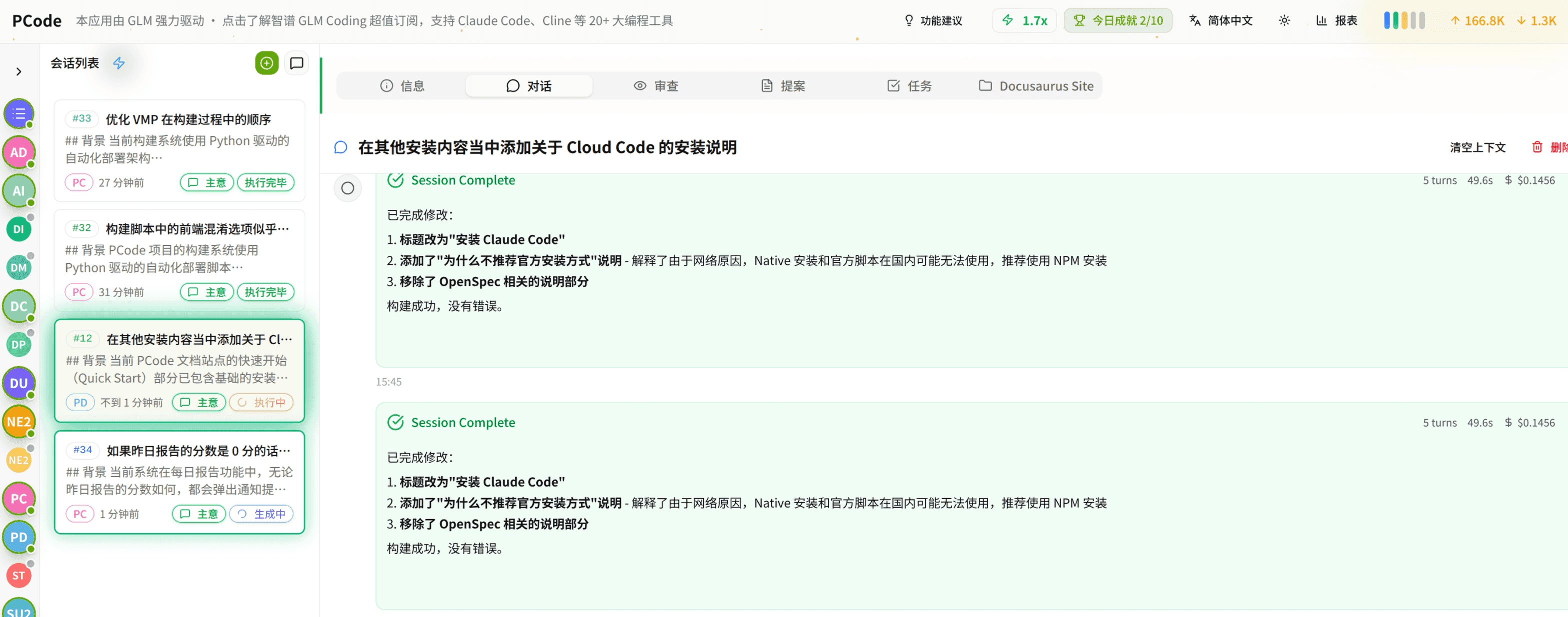
- SmartStructured workflows turn intent into an executable path from idea to shipped change.
- EfficientMulti-agent workflows keep research, implementation, and review moving in parallel.
- FunHero Dungeon interfaces make long coding sessions visual, collaborative, and rewarding.