
Cloud Agents
Source of truth:
src/lib/cloudAgent/andsrc/app/api/v1/agents/tasks/Last updated: 2026-06-28 — v3.8.40 (frontmatter refresh; 4 agents incl. cursor-cloud)
OmniRoute orchestrates third-party cloud-hosted coding agents (Codex Cloud, Cursor, Devin, Jules) as long-running tasks. Each agent is wrapped behind a uniform interface so clients can submit a prompt + repo URL and receive results without dealing with provider-specific APIs.
A Cloud Agent task is not a regular chat completion. It is a durable, multi-step unit of work that may take minutes to hours, can produce a Pull Request as its artifact, and supports follow-up messages and (in some providers) plan approval gates.
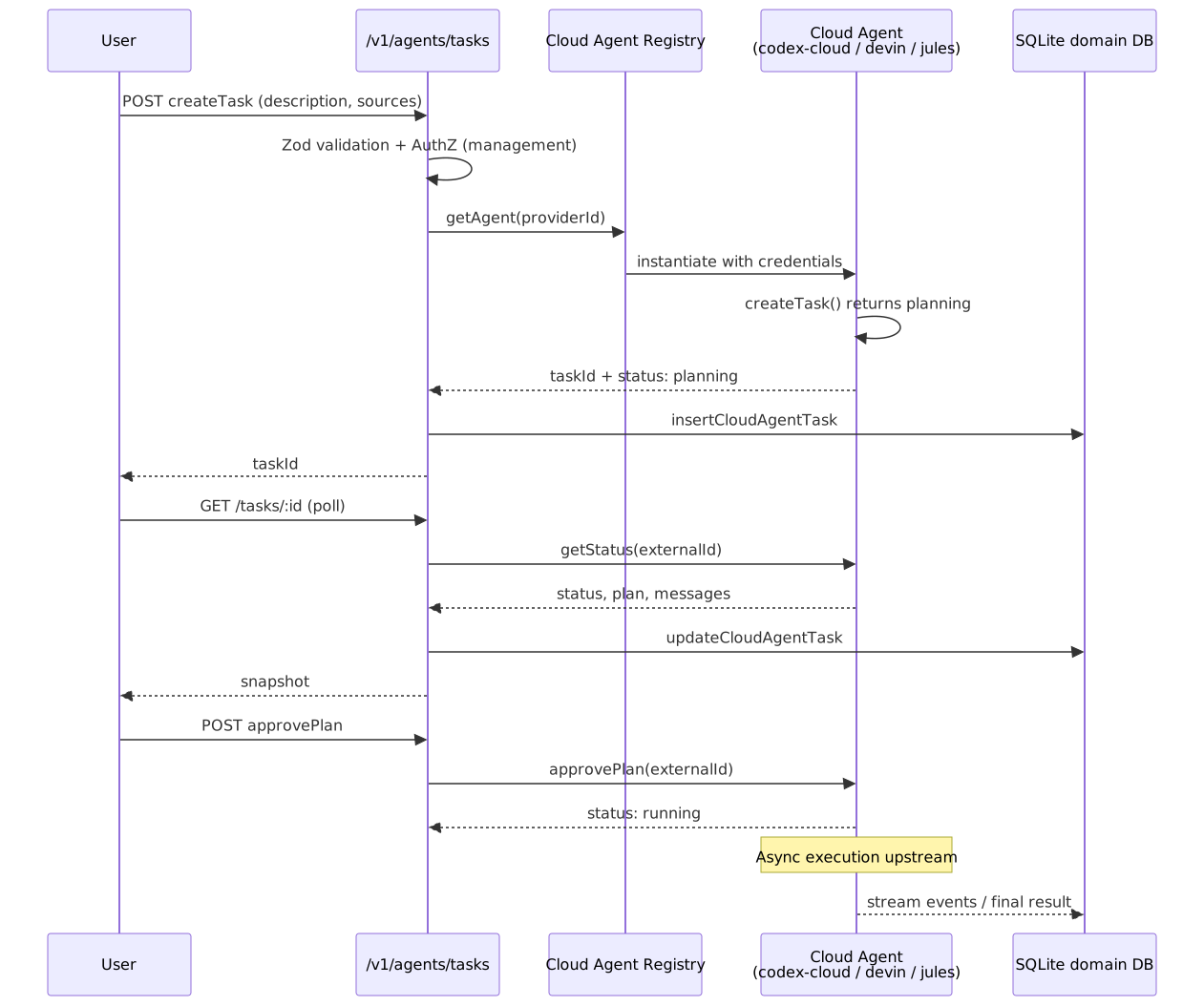
Source: diagrams/cloud-agent-flow.mmd
Supported Agents
Section titled “Supported Agents”| Provider ID | Class | Source | Upstream Base URL | Plan Approval |
|---|---|---|---|---|
jules |
JulesAgent |
src/lib/cloudAgent/agents/jules.ts |
https://jules.googleapis.com/v1alpha |
Yes |
devin |
DevinAgent |
src/lib/cloudAgent/agents/devin.ts |
https://api.devin.ai/v1 |
Yes |
codex-cloud |
CodexCloudAgent |
src/lib/cloudAgent/agents/codex.ts |
https://api.openai.com/v1/codex/cloud |
No (auto) |
cursor-cloud |
CursorCloudAgent |
src/lib/cloudAgent/agents/cursor.ts |
https://api.cursor.com/v0 |
No (auto) |
Registry: src/lib/cloudAgent/registry.ts — exports getAgent(providerId),
getAvailableAgents(), and isCloudAgentProvider(providerId). The registry is a
plain in-memory Record<string, CloudAgentBase> populated at module load.
Architecture
Section titled “Architecture”Client (Dashboard / CLI / API) → POST /api/v1/agents/tasks (management auth required) → CreateCloudAgentTaskSchema validation (Zod) → registry.getAgent(providerId) → getCloudAgentCredentials(providerId) └─ pulls from getProviderConnections({ provider, isActive: true }) (apiKey first, fallback to accessToken) → agent.createTask({ prompt, source, options }, credentials) └─ HTTP POST to upstream provider API └─ returns CloudAgentTask with internal id + externalId → insertCloudAgentTask(...) into cloud_agent_tasks (SQLite)
Polling (lazy sync on read): GET /api/v1/agents/tasks/[id] → getCloudAgentTaskById(id) → agent.getStatus(externalId, credentials) // refreshes status + activities → updateCloudAgentTask(...) with new status, result, completed_at → return serialized task
Interactions: POST /api/v1/agents/tasks/[id] body: { action: "approve" | "message" | "cancel" } → agent.approvePlan(externalId, credentials) for "approve" → agent.sendMessage(externalId, message, credentials) for "message" → status flips to "cancelled" for "cancel" (local-only)Sync is lazy: status is refreshed from the upstream on every GET /tasks/[id].
There is no background poller. Dashboards that need fresh state should poll the GET
endpoint at a sensible interval.
CloudAgentBase Interface
Section titled “CloudAgentBase Interface”Source: src/lib/cloudAgent/baseAgent.ts
export interface AgentCredentials {  apiKey: string;  baseUrl?: string;}
export interface CreateTaskParams {  prompt: string;  source: CloudAgentSource;  options: {    autoCreatePr?: boolean;    planApprovalRequired?: boolean;    environment?: Record<string, string>;  };}
export interface GetStatusResult {  status: CloudAgentStatus;  externalId?: string;  result?: CloudAgentResult;  activities: CloudAgentActivity[];  error?: string;}
export abstract class CloudAgentBase {  abstract readonly providerId: string;  abstract readonly baseUrl: string;
  abstract createTask(p: CreateTaskParams, c: AgentCredentials): Promise<CloudAgentTask>;  abstract getStatus(externalId: string, c: AgentCredentials): Promise<GetStatusResult>;  abstract approvePlan(externalId: string, c: AgentCredentials): Promise<void>;  abstract sendMessage(    externalId: string,    message: string,    c: AgentCredentials  ): Promise<CloudAgentActivity>;  abstract listSources(    c: AgentCredentials  ): Promise<{ name: string; url: string; branch?: string }[]>;
  protected mapStatus(raw: string): CloudAgentStatus; // heuristic upstream-string → enum  protected generateTaskId(): string; // `task_<ts>_<rand>`  protected generateActivityId(): string; // `act_<ts>_<rand>`}
CodexCloudAgent.approvePlan intentionally throws — Codex Cloud auto-plans and has
no approval gate. CodexCloudAgent.listSources returns [].
CursorCloudAgent drives Cursor’s Background / Cloud Agents through its official REST
API (api.cursor.com/v0) with a user or service-account API key — the safer,
first-party alternative to re-using the Cursor IDE’s OAuth session (provider cursor,
which carries a ban-risk warning). It is a plain REST adapter (no @cursor/sdk native
dependency). approvePlan throws (Cursor agents run autonomously); listSources lists
the repositories reachable by the key. Cursor returns UPPERCASE status enums
(CREATING/RUNNING/FINISHED/ERROR), mapped explicitly to the shared
CloudAgentStatus. baseUrl is overridable per-credential so the API version/path can
be corrected without a code change.
Domain Types
Section titled “Domain Types”Source: src/lib/cloudAgent/types.ts
export const CLOUD_AGENT_STATUS = {  QUEUED: "queued",  RUNNING: "running",  AWAITING_APPROVAL: "awaiting_approval",  COMPLETED: "completed",  FAILED: "failed",  CANCELLED: "cancelled",} as const;
export interface CloudAgentSource {  repoName: string;  repoUrl: string; // must be a valid URL  branch?: string;}
export interface CloudAgentResult {  prUrl?: string;  prNumber?: number;  commitMessage?: string;  diffUrl?: string;  summary?: string;  duration?: number; // seconds, positive int  cost?: number; // positive float}
export interface CloudAgentActivity {  id: string;  type: "plan" | "command" | "code_change" | "message" | "error" | "completion";  content: string;  timestamp: string; // ISO 8601  metadata?: Record<string, unknown>;}
export interface CloudAgentTask {  id: string; // internal `task_...` id  providerId: "jules" | "devin" | "codex-cloud" | "cursor-cloud";  externalId?: string; // upstream provider's id  status: CloudAgentStatus;  prompt: string; // 1..10000 chars  source: CloudAgentSource;  options: {    autoCreatePr?: boolean;    planApprovalRequired?: boolean;    environment?: Record<string, string>;  };  result?: CloudAgentResult;  activities: CloudAgentActivity[];  error?: string;  createdAt: string;  updatedAt: string;  completedAt?: string;}
Validation schemas (CreateCloudAgentTaskSchema, UpdateCloudAgentTaskSchema) are
exported alongside the types and are used by the route handlers.
Database
Section titled “Database”Source: src/lib/cloudAgent/db.ts — table is created lazily via
createCloudAgentTaskTable() (also called from src/lib/cloudAgent/index.ts at
module import).
CREATE TABLE IF NOT EXISTS cloud_agent_tasks ( id TEXT PRIMARY KEY, provider_id TEXT NOT NULL, external_id TEXT, status TEXT NOT NULL DEFAULT 'queued', prompt TEXT NOT NULL, source TEXT NOT NULL, -- JSON options TEXT DEFAULT '{}', -- JSON result TEXT, -- JSON activities TEXT DEFAULT '[]', -- JSON error TEXT, created_at TEXT NOT NULL DEFAULT (datetime('now')), updated_at TEXT NOT NULL DEFAULT (datetime('now')), completed_at TEXT);CREATE INDEX IF NOT EXISTS idx_cloud_agent_tasks_provider ON cloud_agent_tasks(provider_id);CREATE INDEX IF NOT EXISTS idx_cloud_agent_tasks_status ON cloud_agent_tasks(status);CREATE INDEX IF NOT EXISTS idx_cloud_agent_tasks_created ON cloud_agent_tasks(created_at DESC);updateCloudAgentTask enforces a column whitelist to prevent SQL injection:
status, prompt, source, options, result, activities, error,
completed_at. Any other key in the partial update is silently dropped.
REST API — Task Lifecycle
Section titled “REST API — Task Lifecycle”Auth: All /api/v1/agents/tasks* endpoints require management auth
(requireCloudAgentManagementAuth wraps requireManagementAuth from
src/lib/api/requireManagementAuth). This is enforced after commit 588a0333
(“fix(auth): require management auth for agent and cooldown APIs”).
| Method | Path | Purpose |
|---|---|---|
| OPTIONS | /api/v1/agents/tasks |
CORS preflight |
| GET | /api/v1/agents/tasks |
List tasks (filter: provider, status, limit≤500) |
| POST | /api/v1/agents/tasks |
Create task (dispatches to upstream + persists) |
| DELETE | /api/v1/agents/tasks?id=... |
Delete task by query id (does not cancel upstream) |
| OPTIONS | /api/v1/agents/tasks/[id] |
CORS preflight |
| GET | /api/v1/agents/tasks/[id] |
Read task + lazy-sync status from upstream |
| POST | /api/v1/agents/tasks/[id] |
Action: approve / message / cancel |
| DELETE | /api/v1/agents/tasks/[id] |
Delete task by path id |
Create task
Section titled “Create task”curl -X POST http://localhost:20128/api/v1/agents/tasks \ -H "Cookie: auth_token=..." \ -H "Content-Type: application/json" \ -d '{ "providerId": "devin", "prompt": "Fix the bug in src/foo.ts where the parser returns null", "source": { "repoName": "user/repo", "repoUrl": "https://github.com/user/repo", "branch": "main" }, "options": { "autoCreatePr": true, "planApprovalRequired": false } }'Response 201:
{ "data": { "id": "task_1731512345678_abc123def", "providerId": "devin", "externalId": "session_xyz", "status": "queued", "prompt": "...", "source": { "repoName": "user/repo", "repoUrl": "...", "branch": "main" }, "options": { "autoCreatePr": true }, "createdAt": "2026-05-13T12:34:56.789Z" }}Approve a plan
Section titled “Approve a plan”curl -X POST http://localhost:20128/api/v1/agents/tasks/<id> \ -H "Cookie: auth_token=..." \ -H "Content-Type: application/json" \ -d '{"action":"approve"}'Send a follow-up message
Section titled “Send a follow-up message”curl -X POST http://localhost:20128/api/v1/agents/tasks/<id> \ -d '{"action":"message","message":"Also add a unit test for the parser"}'Cancel (local status only)
Section titled “Cancel (local status only)”curl -X POST http://localhost:20128/api/v1/agents/tasks/<id> \ -d '{"action":"cancel"}'cancel flips status to "cancelled" in the local DB but does not call the
upstream provider — there is no abort RPC in CloudAgentBase. To stop billing
upstream, terminate the task in the provider’s own console.
REST API — Cloud Provider Plumbing
Section titled “REST API — Cloud Provider Plumbing”These auxiliary endpoints under src/app/api/cloud/ are used by remote clients
(the CLI, the Electron app, or sync workers) to read provider connection metadata
and resolve model aliases. They are authenticated with a regular API key
(via validateApiKey), not the management auth used by the task endpoints.
| Method | Path | Purpose |
|---|---|---|
| POST | /api/cloud/auth |
Validate API key, return masked connection metadata + model aliases |
| PUT | /api/cloud/credentials/update |
Refresh accessToken / refreshToken / expiresAt |
| POST | /api/cloud/model/resolve |
Resolve a model alias to { provider, model } |
| GET | /api/cloud/models/alias |
List all model aliases |
| PUT | /api/cloud/models/alias |
Set a model alias (and auto-sync to Cloud if enabled) |
/api/cloud/auth never returns raw apiKey / accessToken / refreshToken. It
returns hasApiKey, hasAccessToken, hasRefreshToken, and a masked preview
(maskedApiKey: first 4 + **** + last 4).
Credentials Resolution
Section titled “Credentials Resolution”getCloudAgentCredentials(providerId) in src/lib/cloudAgent/api.ts:
- Loads active provider connections via
getProviderConnections({ provider: providerId, isActive: true }). - For each connection, prefers
apiKey(trimmed). Falls back toaccessToken. - Returns the first non-empty token wrapped as
{ apiKey: token }. - Returns
nullif no usable token is found — the API responds400with"No active credentials configured for cloud agent provider: <id>".
This means Cloud Agents reuse the same Provider Connection table as regular LLM
providers. To enable Jules, create an active connection with provider: "jules"
and a populated apiKey.
Dashboard
Section titled “Dashboard”Source: src/app/(dashboard)/dashboard/cloud-agents/page.tsx
A "use client" React page that:
- Lists tasks (polled via
GET /api/v1/agents/tasks). - Submits new tasks via a form that maps to
CreateCloudAgentTaskSchema. - Shows status badges (
queued,running,awaiting_approval,completed,failed,cancelled) and renders theactivities[]timeline. - Surfaces the
result.prUrl/commitMessage/summarywhenstatus === "completed".
Integration with A2A
Section titled “Integration with A2A”Cloud Agents can be exposed as A2A skills by registering an A2A skill that delegates
its tasks/send handler to getAgent(...).createTask(...) and translates A2A task
status events to the JSON-RPC 2.0 protocol. See A2A-SERVER.md.
Adding a New Cloud Agent
Section titled “Adding a New Cloud Agent”- Create
src/lib/cloudAgent/agents/<name>.tsextendingCloudAgentBase. - Implement
createTask,getStatus,approvePlan(or throw if N/A),sendMessage,listSources. Usethis.mapStatus(...)for status normalization. - Register in
src/lib/cloudAgent/registry.tsunder a stableproviderId. - Extend the
providerIdliteral union insrc/lib/cloudAgent/types.ts(CloudAgentTask.providerIdandCreateCloudAgentTaskSchema). - Add the provider to
src/shared/constants/providers.tsif it needs a connection record. OAuth-based providers also needsrc/lib/oauth/providers/. - Add tests under
tests/unit/cloud-agent-*.test.ts. - Update this doc and the dashboard’s
CLOUD_AGENTSconstant.
Configuration
Section titled “Configuration”| Env Var | Purpose |
|---|---|
DATA_DIR |
Location of the SQLite database holding cloud_agent_tasks |
JWT_SECRET |
Required for management auth on task endpoints |
API_KEY_SECRET |
Required to encrypt provider connection credentials at rest |
No Cloud-Agent-specific env vars exist today — every secret lives in the
provider_connections table.
See Also
Section titled “See Also”- A2A-SERVER.md
- API_REFERENCE.md
- SKILLS.md
- MEMORY.md
- Source:
src/lib/cloudAgent/ - Routes:
src/app/api/v1/agents/tasks/,src/app/api/cloud/ - Dashboard:
src/app/(dashboard)/dashboard/cloud-agents/page.tsx
HagiCode
HagiCode is an agentic coding workspace. Rich, convenient UI interactions make planning, agent execution, and project work approachable and easy to navigate, creating an engaging development experience.
Explore an engaging development experience through rich, convenient UI interactions.

- SmartOpenSpec workflows turn intent into an executable path, from proposal to design, tasks, and a shipped change.
- EfficientMulti-agent execution keeps research, implementation, and review moving in parallel, across several repositories and the Agent CLIs you already use.
- InterestingRich, convenient UI interactions make planning, agent execution, and project work approachable and easy to navigate.
Download for Windows
Share HagiCode

Turn ideas into shipped software.
HagiCode is an agentic coding workspace. OpenSpec workflows plan the change, multi-agent execution carries it out, and Hero Scenario makes the long run visible, so ideas become shipped software.
- Smart
- OpenSpec workflows turn intent into a path from proposal to shipped change.
- Efficient
- Multi-agent execution runs research, build, and review in parallel.
- Fun
- Rich UI interactions make planning, agent work, and projects easier to follow.
© 2026 HagiCode | Powered By hagilight-starlight@0.21.0 | Branch: main | Commit: de60bcd | Built: