OpenCode conversation identity
OpenCode and OpenCode Go reuse explicit conversation IDs across turns. The
resolver checks x-opencode-session, existing affinity/session headers, native
CLI session/thread headers, request metadata, and then top-level session/thread
fields. Claude’s JSON-encoded metadata.user_id is inspected for a session ID;
an opaque account/user ID alone is never treated as a conversation ID.
Values containing control characters, empty IDs and IDs longer than 256 characters are ignored. JSON metadata parsing is bounded. Before translation, the executor header normalizer preserves this identity only for the OpenCode providers; it does not inject OpenCode headers for other providers.
The existing canonical ses_ encoding and conversation fingerprint fallback
remain unchanged. With no explicit ID, the first user message and other
existing fingerprint inputs continue to determine continuity. This is not a
new authorization boundary or proof of upstream content isolation.
The implementation lives in open-sse/utils/opencodeSessionIdentity.ts,
open-sse/utils/opencodeHeaders.ts and
open-sse/handlers/chatCore/executorClientHeaders.ts. Regression tests cover
native IDs, Claude metadata, precedence, invalid values and the existing
fingerprint behavior without paid upstream calls.
HagiCode
HagiCode ist ein agentischer Coding-Arbeitsplatz mit strukturierten Workflows, Multi-Agent-Ausführung und Hero-Dungeon-Ansichten.
Mit einem intelligenteren, schnelleren und unterhaltsameren agentischen Workflow wird aus Ideen nutzbare Software.
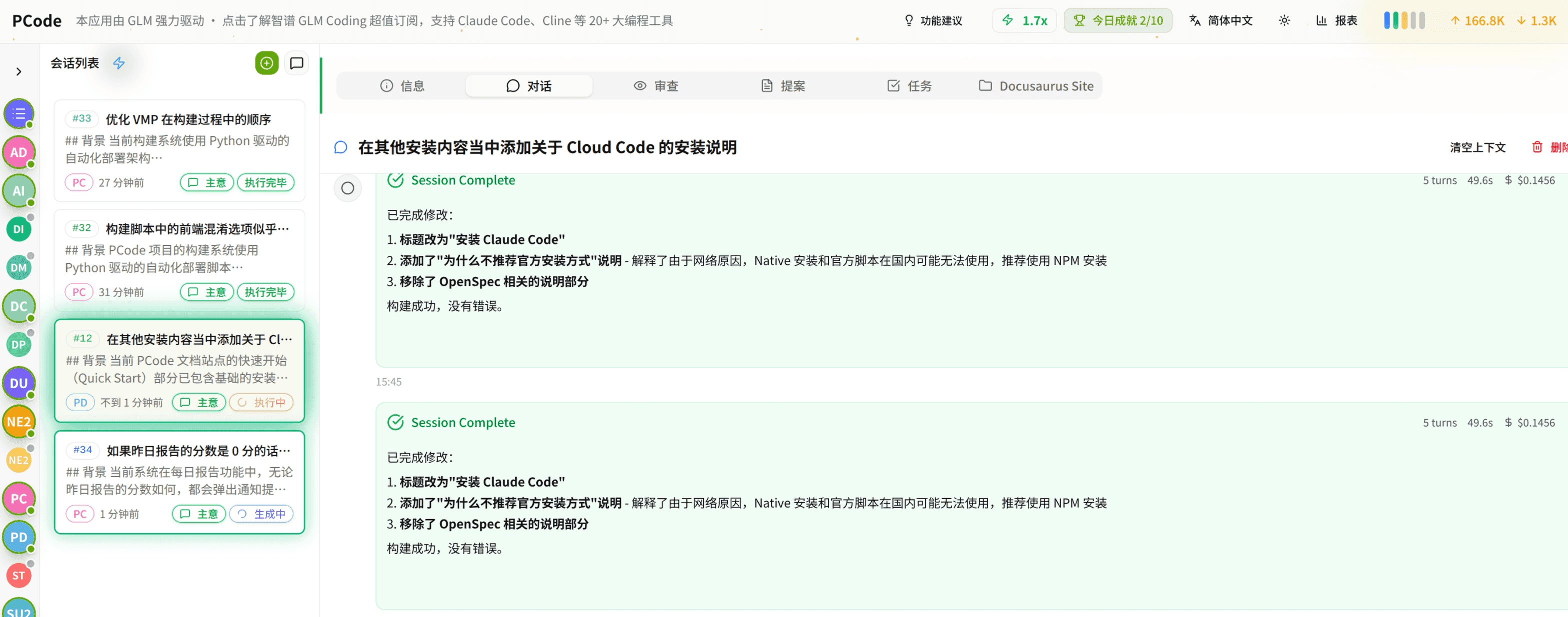
- SmartStrukturierte Workflows machen aus Absichten einen umsetzbaren Weg von der Idee bis zur Auslieferung.
- EfficientMulti-Agent-Workflows führen Recherche, Umsetzung und Prüfung parallel aus.
- FunHero Dungeon macht lange Coding-Sitzungen anschaulich und gemeinschaftlich.